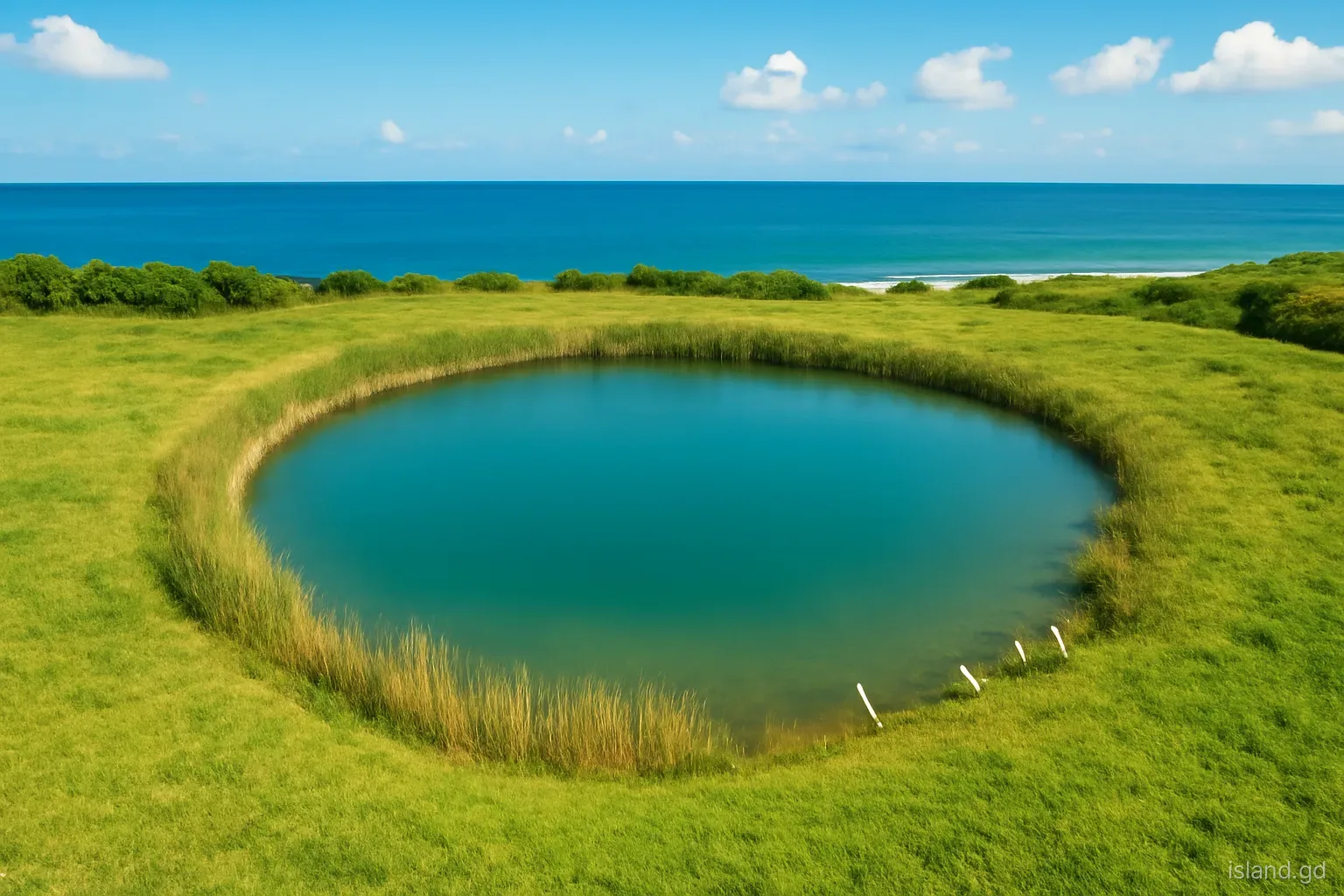
Most visitors to Grenada know Grand Etang, the crater lake in the cloud-wrapped central mountains. Far fewer make it to Lake Antoine, its low-lying counterpart in the parish of St Patrick, close to the north-east coast. Set among farmland and pasture, a short distance from the old River Antoine estate, it looks at first like an ordinary pond. In fact it is the water-filled crater of a volcanic explosion, one of the clearest pieces of evidence of Grenada's fiery origins.
Lake Antoine is a quiet place with few facilities, little signage and no crowds. That is its appeal for birdwatchers, walkers and anyone interested in how the island was formed. This profile explains how the lake came to be, what lives in and around it, how to visit and what else to see in the area, which is one of Grenada's most rewarding and least visited corners.
How an explosion crater became a lake
Lake Antoine is generally described by geologists as a maar, a broad, shallow crater formed when rising magma meets groundwater. The contact flashes the water to steam, triggering violent explosions that blast out a crater, often surrounded by a low rim of fragmented rock and ash, rather than building a tall volcanic cone. When activity stops, the crater frequently fills with water, producing a lake whose surface lies close to the level of the surrounding land.
This explains why Lake Antoine looks so different from Grand Etang. Grand Etang sits in a crater high on the central ridge, surrounded by mountains. Lake Antoine lies at low elevation near the coast, ringed by gentle slopes and fields. Both, however, belong to the same long story of volcanic activity that built Grenada. Scientists who study the island's geology point to features such as Lake Antoine as evidence that volcanism on Grenada continued in several places, not just at the main mountain centres. There has been no eruption here in recorded history, and the lake is considered part of an extinct volcanic system.
What the lake looks like today
The lake is roughly circular and relatively shallow, with its size and depth varying with the seasons. In the rainy season, roughly June to November, it fills and its edges spread into surrounding vegetation; in a long dry season it can shrink noticeably, exposing muddy margins. Reeds, grasses and water plants grow around the edges, and the surrounding slopes are a patchwork of pasture, scrub and small farm plots, with cattle and goats often grazing nearby.
There is no visitor centre, café or formal facility at the lake. A rough path follows parts of the rim, offering views across the water to the hills inland and, from higher points, glimpses of the Atlantic coast. The ground can be muddy after rain and overgrown in places, so sturdy shoes and long trousers are sensible. Because the area is farmland and some of it is privately owned, stay on established paths, close any gates you pass through and ask permission if you are unsure whether you can cross a field.
Birds and wildlife to look for
Wading birds. Herons and egrets are the most visible birds at the lake, stalking the shallows for fish, frogs and insects. Cattle egrets follow livestock in the surrounding fields.
Waterbirds. Gallinules and other rails move through the reeds, and ducks, including seasonal visitors from North America in the northern winter, sometimes rest on the open water.
Migrants. As a freshwater site near the coast, the lake can attract migrant shorebirds and waterfowl during the northern autumn and winter. Local birders consider it worth checking regularly for unusual visitors.
Land birds. The scrub and trees around the rim hold common Grenadian species such as bananaquits, Carib grackles, doves and hummingbirds.
Other life. Frogs, dragonflies and small fish are part of the lake's ecology, and mongooses and lizards are often seen on the paths. Bring binoculars; many sightings are at a distance.
Why a small lake matters
Grenada has very few natural bodies of standing freshwater. Rivers and streams run off the mountains quickly, and the island's main lakes and ponds can be counted on one hand: Grand Etang in the interior, Lake Antoine in the north-east and the brackish, mangrove-fringed Levera Pond at the northern tip. That scarcity gives Lake Antoine an importance out of proportion to its size, both as a habitat for wetland birds and plants and as a feature of the landscape that tells the island's volcanic story.
Small freshwater wetlands like this one are vulnerable. Runoff from surrounding farmland can carry soil and fertiliser into the water, encouraging algae and weeds; dry years shrink the lake; and dumping or clearing along the edges damages the habitat that birds rely on. Visitors can help simply by leaving no trace, keeping noise down and supporting local guides who know the area. Anyone with a serious interest in birds can also share sightings with local birding and conservation groups, whose records help track how the lake and its wildlife change over time.
Getting there and when to go
Lake Antoine lies inland from the north-east coast of Grenada, near the River Antoine Rum Distillery, which still makes rum using a water wheel and traditional methods. The lake is reached by car via the roads of St Patrick and St Andrew, either along the east coast through Grenville or across the north from Sauteurs. Roads in this area are narrow and winding, and the final approach is on minor roads with limited signage. A local driver or guide makes finding it much simpler, and minibuses run on the main roads, though not to the lake itself.
Early morning is the best time to visit, for the light, the birds and the cooler temperatures. The dry season, from about January to May, offers easier walking, although the lake may be smaller; the rainy season brings a fuller lake and lusher surroundings, but muddier paths. Because there are no facilities, bring water, sun protection and insect repellent, and plan to combine the lake with other sights in the north-east rather than making a long trip just for it.
Combining Lake Antoine with the north-east
The lake sits in one of Grenada's most interesting areas, and a day in the north-east can include several contrasting sights:
- River Antoine Rum Distillery. One of the oldest working distilleries in the Caribbean, using a water wheel to crush sugar cane. Tours have long been offered; check current arrangements before going.
- Levera National Park. At the island's northern tip, with a mangrove-fringed pond, a long beach where turtles nest in season and views of the offshore islets, including Sugar Loaf and Green Island.
- Bathway Beach. On the north-east coast near Levera, with a natural reef forming a sheltered pool for wading close to shore. Swim only within the protected area, as currents beyond the reef are strong.
- Sauteurs. The northern town, with Leapers' Hill, a site associated with the last stand of the Kalinago people against French colonists in the seventeenth century.
- Grenville. Grenada's second town, on the east coast, with a market and a working waterfront.
Pitfalls and good practice
The biggest mistake with Lake Antoine is expecting a managed attraction. There is no entry desk, no guided walk on site and little interpretation, so it can feel underwhelming to anyone who arrives without knowing why it matters. Reading up on its volcanic origin, or going with a guide who can explain the landscape and the birds, makes the visit far more rewarding. It also helps to set expectations about the lake's appearance, which changes with the seasons.
Respect for the land matters too. The area around the lake is farmland, and the people who work it depend on it for their living. Do not walk through crops, disturb livestock or leave gates open. Avoid swimming or wading, as the water is shallow, muddy and, like most tropical freshwater, can carry risks such as leptospirosis. Take all rubbish away with you. If you are photographing birds, keep a respectful distance, and avoid flushing them from the water for a better shot.
Frequently asked questions
Where is Lake Antoine in Grenada?
Lake Antoine is in the parish of St Patrick, inland from Grenada's north-east coast and near the River Antoine Rum Distillery. It is reached by narrow minor roads, so a local driver or guide makes it easier to find. It combines well with Levera, Bathway Beach and Sauteurs.
Is Lake Antoine a volcanic crater?
Yes. Lake Antoine is generally described as a maar, a shallow volcanic crater formed when magma met groundwater and caused violent steam explosions. The crater later filled with water. There has been no eruption in recorded history, and the volcanic system is considered extinct.
Is there an entry fee for Lake Antoine?
There is generally no formal entry fee or visitor centre at Lake Antoine, which is surrounded by farmland. Visitors usually walk paths around the rim. Because some land is privately owned, stay on established paths and ask permission if unsure. A guide may charge for their services.
Is Lake Antoine good for birdwatching?
Yes. It is one of Grenada's more accessible freshwater sites, attracting herons, egrets, gallinules and seasonal ducks and shorebirds, especially in the northern winter. Early morning visits with binoculars give the best results. Local birders often check it for unusual migrants.
How does Lake Antoine differ from Grand Etang?
Both are crater lakes, but Grand Etang lies high in the cloudy central mountains surrounded by rainforest, while Lake Antoine sits at low elevation near the coast among farmland and pasture. Grand Etang has a visitor centre and trails; Lake Antoine is quieter, with few facilities.