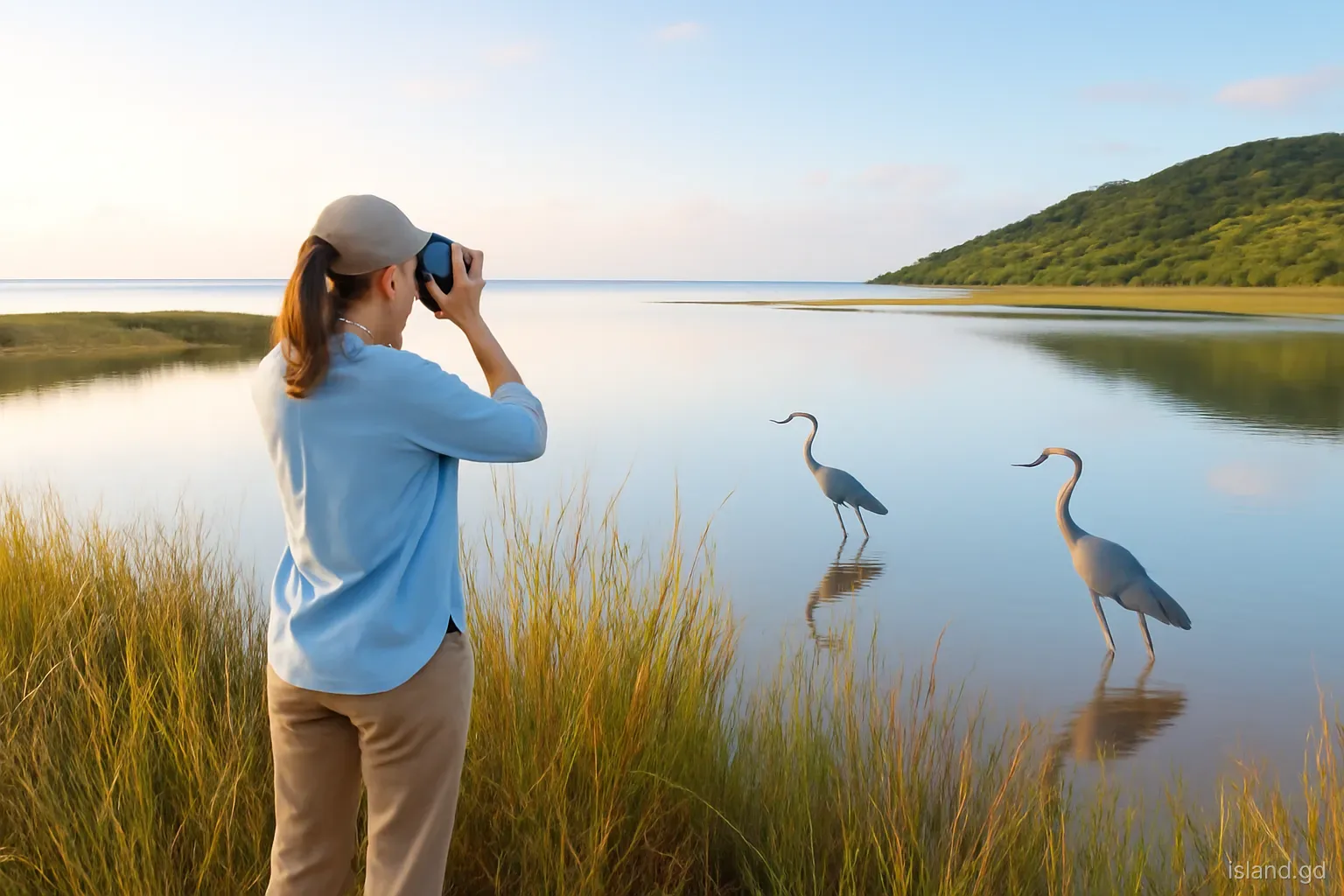
Grenada is not a high-volume birding destination like Trinidad, but it rewards anyone who looks properly. The island sits at a hinge: species from the Lesser Antilles to the north meet birds whose main range is South America, and the habitats change fast, from wet montane forest to cactus scrub within a short drive. A morning at the right site can produce regional specialities, wintering North American migrants and a good list of waterbirds.
The key is matching site to species. The Grenada dove will never be found in the rainforest; the Lesser Antillean tanager will not turn up on a salt pond. The seven areas below cover most of what the islands offer, with notes on what to expect and how to plan.
1. Grand Etang Forest Reserve: the mountain forest
The forest around Grand Etang Lake, in the central mountains of St Andrew, is the place for Grenada's forest birds. The Lesser Antillean tanager, a regional speciality found only on Grenada and St Vincent, moves through the canopy in small groups; it has a golden-brown body and a rufous-capped head with a bluish sheen. Cocoa thrushes feed on the ground and on trails, and the Grenada flycatcher, shared with St Vincent and the Grenadines, calls from exposed perches.
Raptors are often seen overhead: broad-winged hawks soar above the ridges, and the rainforest trails offer chances of hermit hummingbirds, the purple-throated carib in the wettest areas, and scaly-naped pigeons crossing the valleys. Mona monkeys are a bonus.
Practical points: go early, as cloud and rain build through the day at this altitude, and bring rain gear even in the dry season. Trails can be muddy and slippery. The visitor area and its surroundings are productive in themselves, so a slow first hour near the lake and road edges is often better than marching off on a long hike.
2. The dry south and west coasts: dove country
The leeward lowlands, especially around Mount Hartman on the south coast and the hills near Halifax Harbour on the west, hold the dry deciduous forest that supports the Grenada dove. The same habitat is home to the very rare Grenada form of the hook-billed kite, a raptor that feeds largely on tree snails and is treated by some authorities as a distinct subspecies found nowhere else.
Dry forest also suits species such as the mangrove cuckoo, Caribbean elaenia, Lesser Antillean bullfinch and various grassquits and seedeaters. Bird activity drops sharply by mid-morning in the heat, so arrive at first light and listen for the dove's single repeated note.
Access to these areas is complicated by private land, development and changing trail conditions. Arranging a visit through a birding guide or the Forestry and National Parks Department avoids wasted journeys and trespassing.
3 to 5. Wetlands, lakes and salt ponds
Levera Pond, St Patrick. The brackish pond and mangroves behind Levera Beach in the north-east are among the best wetland sites on the mainland. Expect herons and egrets, including little blue and tricoloured herons, as well as gallinules, kingfishers in winter and a range of migrant shorebirds. The surrounding area is part of Levera National Park.
Lake Antoine, St Patrick. This shallow crater lake near River Antoine holds waterbirds such as least grebes, gallinules and ducks in some seasons, and the surrounding farmland is good for open-country birds. It is close enough to Levera to combine both in one morning.
La Sagesse, St David. On the south-east coast, the salt pond and mangroves near La Sagesse Bay attract herons, sandpipers and other waders, especially from late summer through the northern winter. The mix of beach, mangrove and woodland means a short walk can produce a varied list.
Timing. Wetland birding is best from roughly August to April, when North American shorebirds and some ducks pass through or spend the winter. Water levels fall in the dry season, which can concentrate birds in smaller pools.
6. Carriacou: dry hills and lagoons
Carriacou is drier and lower than the mainland, and its birdlife reflects that. The scrubby hills, including the forested slopes of High North in the north of the island, support doves, the scaly-naped pigeon, bananaquits, Caribbean elaenias, grassquits and the Antillean crested hummingbird. Raptors such as the American kestrel hunt over open ground.
The mangroves and lagoons around Tyrrel Bay and in the south and east of the island are worth checking for herons, egrets and shorebirds, and the coastline brings frequent views of brown pelicans, frigatebirds and terns. Hurricane Beryl in July 2024 caused severe damage to vegetation and mangroves on Carriacou, so conditions at specific sites may differ from older descriptions; check locally before planning around a particular location.
A day trip by ferry or flight from the mainland can work, but an overnight stay allows early morning birding, which is far more productive than the middle of the day.
7. Offshore islets: seabirds from the water
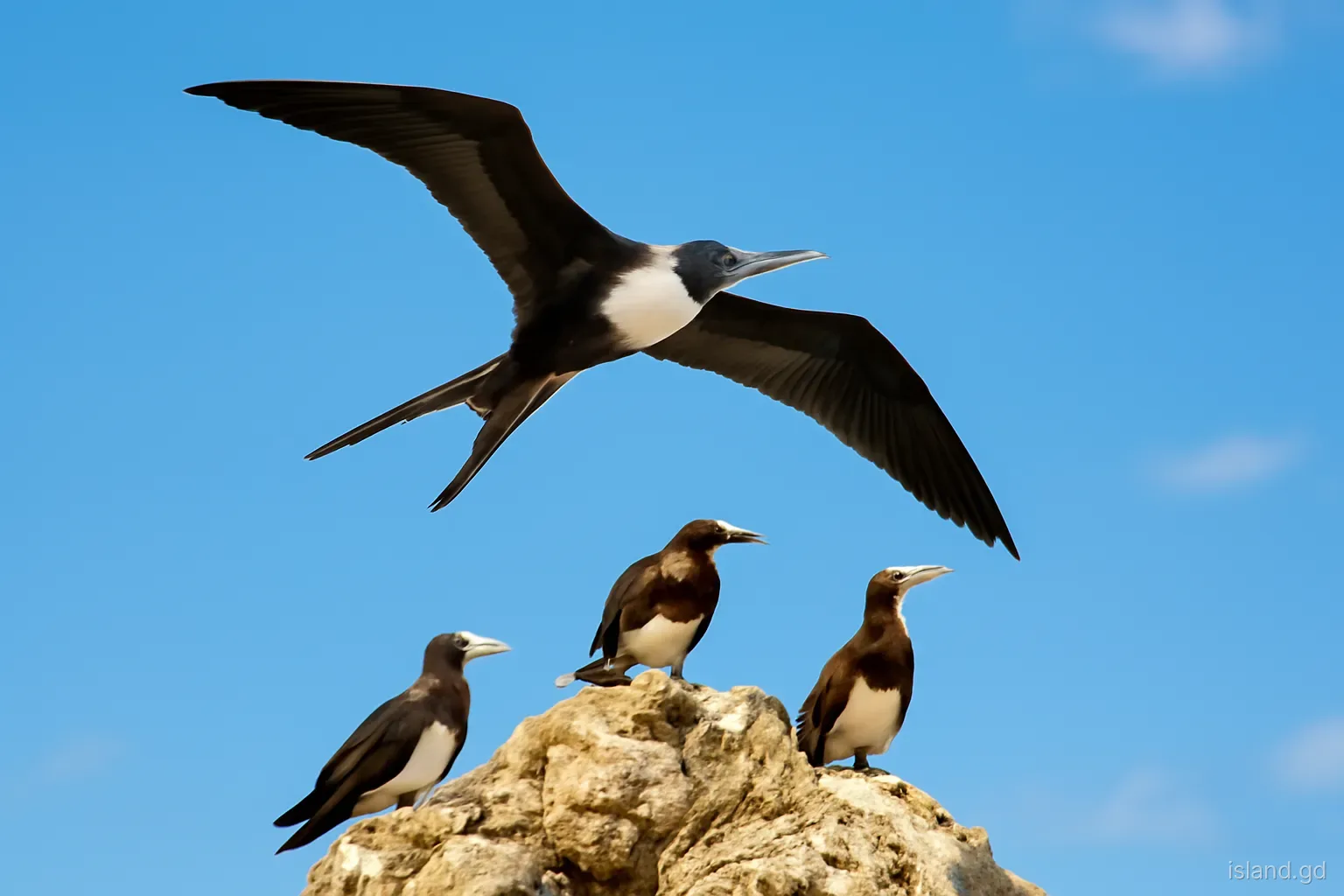
The rocky islets off the north coast of Grenada and around the Grenadines, such as Sugar Loaf, Green Island and Sandy Island off Levera, and the small rocks north of the mainland, are where seabirds roost and in some cases nest. Brown boobies, magnificent frigatebirds, brown pelicans, laughing gulls and several tern species can be seen, and red-billed tropicbirds use cliff ledges in parts of the region.
These islets are best viewed from a boat at a respectful distance. Landing on nesting islands, especially during the breeding season, can cause adults to abandon eggs and chicks to overheat in the sun. Ask boat operators to keep their distance and to cut engine noise close to colonies.
Any sailing trip between Grenada and Carriacou offers seabird chances along the way, and the passage past the volcanic area north of the mainland is often good for frigatebirds and boobies following fish.
Putting the sites together: a sensible birding plan
Grenada is small enough that several habitats can be covered in a day, but trying to do everything usually means arriving at each site in the worst of the heat. A more productive pattern is one main habitat per morning, with an easy wetland or garden stop in the late afternoon.
A typical approach is to spend the first morning at Grand Etang for forest species, returning to the south for an evening walk along the coast. A second morning can be given to the dry forest for the Grenada dove with a guide, and a third to the north-east, starting at Levera Pond at first light, continuing to Lake Antoine, and returning via the east coast. Carriacou, if included, deserves at least one night so that an early start is possible.
Road times are short on the map but slow in reality: the drive from the south coast to Levera can take well over an hour on winding roads, and the climb to Grand Etang is steep. Build in time for traffic around St George's and for stops. Keep a simple list each day and note where and when each species was seen; patterns quickly emerge, and the notes are useful to local conservation groups that track bird populations.
Planning tips and common mistakes
A little preparation makes a big difference to a birding trip in Grenada, where distances are short but conditions vary sharply.
- Start at dawn. In the tropics, bird activity peaks in the first two to three hours after sunrise and again in late afternoon.
- Bring a field guide that covers the southern Lesser Antilles; guides that only cover the northern Caribbean miss South American species found here.
- Hire a local guide for the dry forest and for Grand Etang if you want specialities. Guides know which trails are open and where birds have been seen recently.
- Expect rain in the mountains at any time of year and keep binoculars in a dry bag.
- Avoid playing recordings to attract rare species, particularly the Grenada dove and hook-billed kite.
- Do not assume the commonest dove or hummingbird is the rare one. Most mistakes are misidentified common birds.
Frequently asked questions
What are the special birds to look for in Grenada?
The Grenada dove is the island's only endemic species. The Grenada hook-billed kite is a rare endemic form. Regional specialities include the Lesser Antillean tanager, Grenada flycatcher and cocoa thrush, alongside South American species near the edge of their range.
When is the best time of year for birdwatching in Grenada?
Resident forest birds can be seen year-round. From about August to April, North American migrants add shorebirds, warblers and some ducks. The dry season, roughly January to May, makes trails easier, while the start of the rains brings more song and breeding activity.
Is a guide needed for birdwatching in Grenada?
Common birds can be seen without a guide in gardens and at Grand Etang. For the Grenada dove, the hook-billed kite and dry forest sites, a guide is strongly recommended because access, land ownership and bird locations change and are not obvious.
How many bird species have been recorded in Grenada?
The national list runs to roughly 150 or more species once migrants and vagrants are included, though the exact figure depends on which records are accepted. The number of resident breeding species is considerably smaller.
Is Carriacou worth visiting for birds?
Carriacou has a smaller and drier set of species than the mainland, but its lagoons, scrub and coastline are pleasant to bird, and seabirds are easy to see. It is best combined with other reasons to visit rather than treated as a dedicated birding trip.