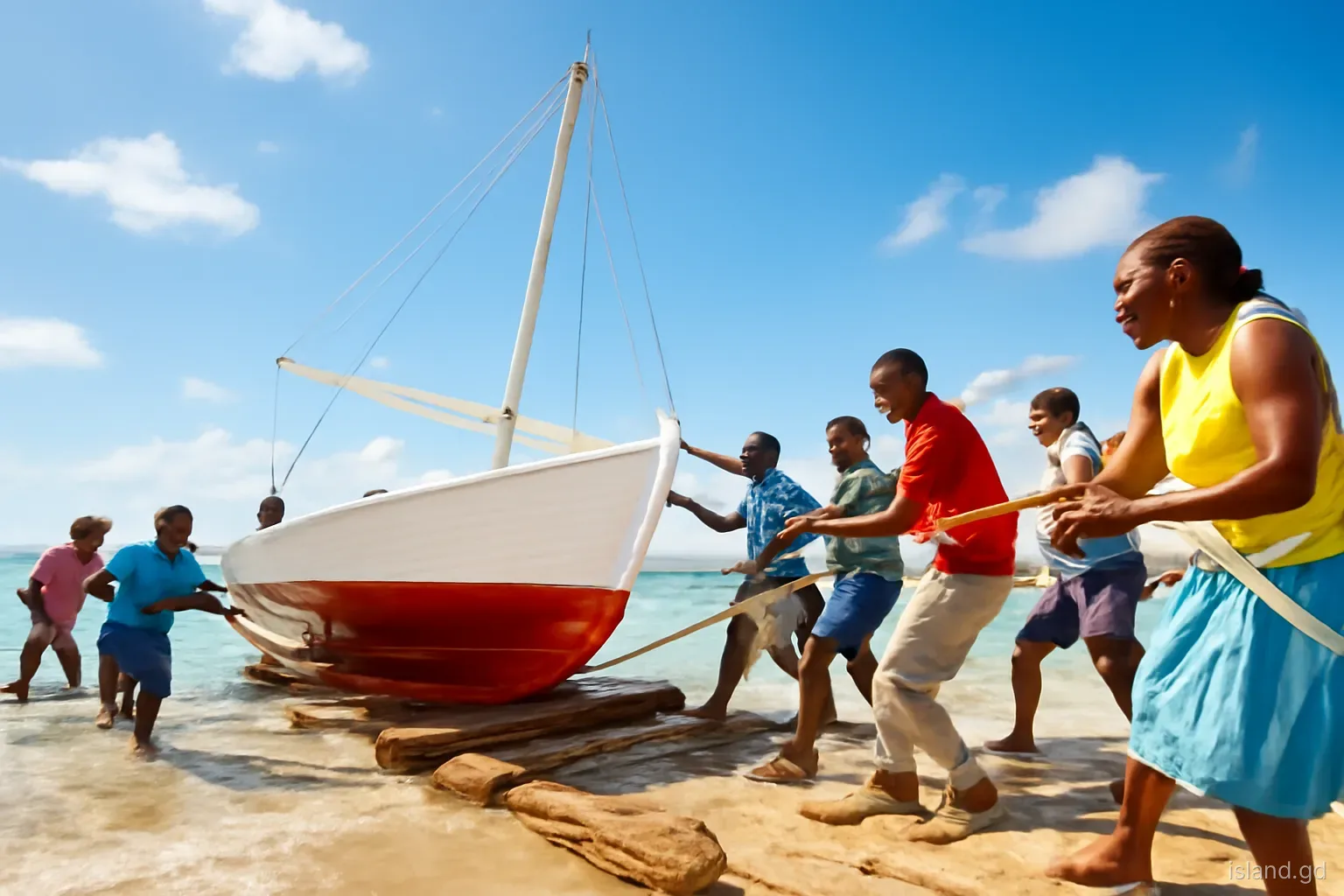
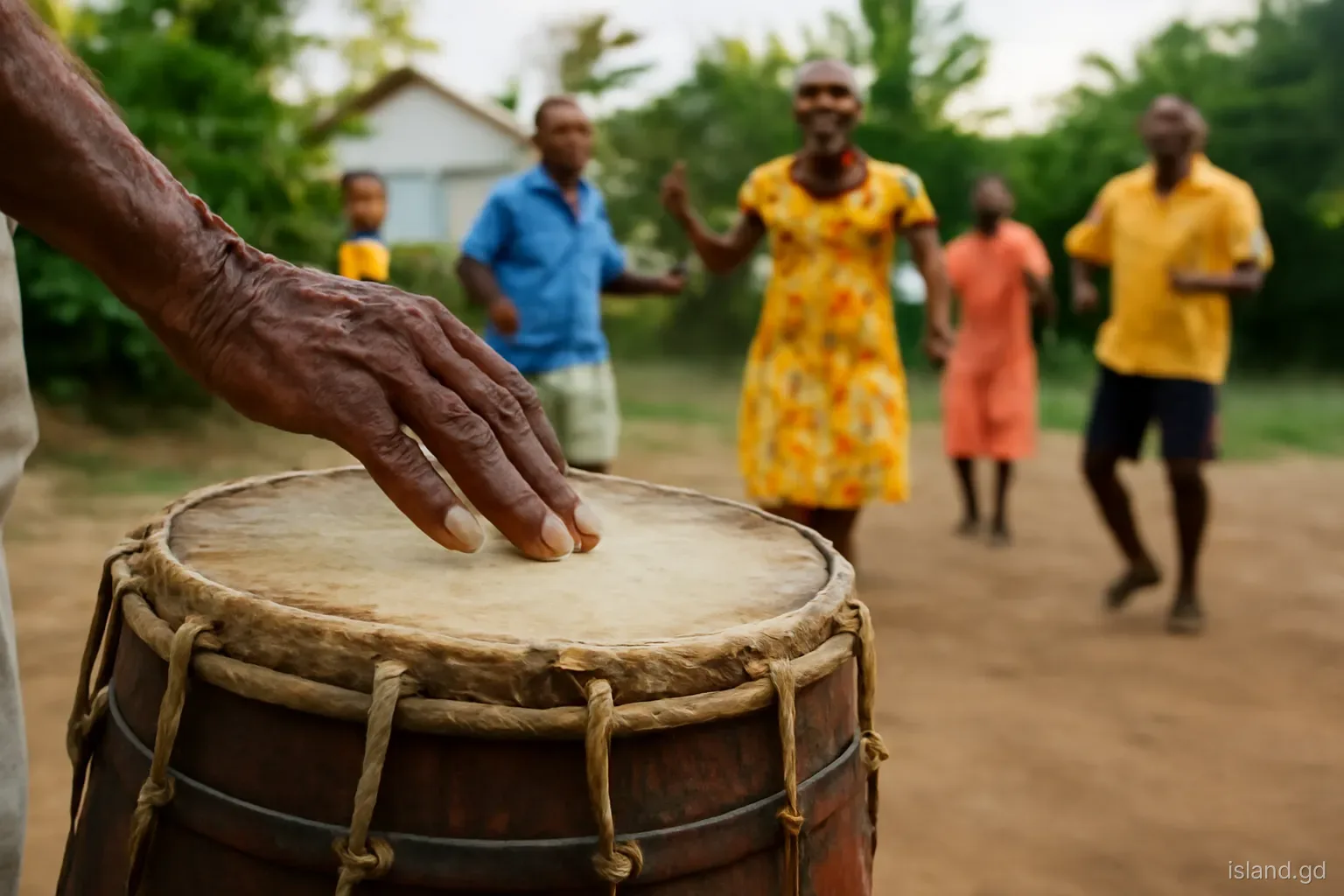
On Carriacou a Big Drum is not a concert. It is a ceremony that happens in a yard, usually at night, because a family has a reason to hold one: a stone feast for a relative who died, a new boat about to touch the water, a house finished, a dream that told someone the old people wanted to be remembered. Three drummers sit on their kegs, a lead singer raises a song, a ring of women answers, and one dancer at a time steps into the open ground in front of the drums.
The dance carries the names of West African peoples whose descendants were enslaved on the island: Cromanti, Ibo, Manding, Chamba, Arada, Kongo, Temne, Moko and others. Many Carriacouans can still say which nation their family descends from, and the Big Drum is one of the few places in the Caribbean where that memory of origin has been kept in the open, generation after generation. Knowing how a drum night is put together makes it far easier to watch respectfully and to understand what you are seeing.
Why it is called the Nation Dance
Under slavery, people brought to Carriacou from different parts of West Africa kept some sense of belonging to their own group, and the dances and songs associated with each group survived in a protected form. After emancipation in 1838 the island's small size, its isolation from the plantation economy of the mainland and its tight family networks helped those forms survive where they faded elsewhere. The result is a repertoire in which particular songs and rhythms belong to particular nations.
Older people in Carriacou often describe the purpose very plainly: the dance is for the ancestors, the 'old parents'. A Big Drum is a way of calling them, feeding them, honouring them and asking for their goodwill. That is why it appears at life events rather than on a fixed entertainment calendar, and why the first songs of the night are treated with more seriousness than the later ones.
Folklorists recorded Big Drum music on Carriacou in the middle of the twentieth century, and those recordings are still studied today. The tradition did not need outside attention to survive, though; it has been passed on in villages such as L'Esterre, Harvey Vale, Mount Pleasant, Windward and Bogles by drummers and singers who learned it as children.
The three drums and who plays them
The boula drums. Two of the three drums are boulas. They lay down the steady, repeating pattern that holds the whole performance together. The boula players rarely change what they do, and that steadiness is what lets the lead drummer and the dancer play against it.
The cot, or cutter. The middle drum, often called the cot or cutter, is the lead. Its player answers the dancer's feet, marks changes of step and adds the sharp accents that make the dance exciting. A good cot drummer watches the dancer constantly. Traditionally a string or wire strung with pins or similar small objects runs across the head to give a buzzing edge to the sound.
How the drums are made. The classic Big Drum is built from a wooden rum keg or similar cask, with a goatskin head held by hoops and rope or cord. Drummers usually sit astride the drum or with it between their knees and play with bare hands. Tuning by warming the skin near a fire was once common before playing.
The shak-shak and other sounds. A shaker, sometimes called a shak-shak, and the hand claps of the singers add to the texture. Nothing is amplified at a traditional drum, which is part of why the music feels so close.
Who plays. Drumming has historically been a male role and singing and dancing heavily female, though this is not an absolute rule. Respected drummers are known across the island by name, and families planning a feast will try to secure particular players well in advance.
The chantwell, the chorus and the dancers
Every song is led by a chantwell, the lead singer who raises the line and decides when to move on. The chorus, mostly women standing or sitting in a semicircle near the drums, answers in a call-and-response pattern. Many songs are in a Creole that mixes French-derived words with African and English elements; some lines are old enough that even singers may not translate them literally, but they know exactly which nation and occasion each belongs to.
The dancing takes place in the open space in front of the drums, usually one dancer at a time, sometimes a pair. Women dance in long, full skirts and head-ties, holding and swinging the hem so the fabric becomes part of the movement. Men dance too, with a different, often more athletic style. Dancers acknowledge the drums, and a performance may end with a gesture toward the cot drummer, who closes the phrase with them.
Watch the footwork and the conversation between dancer and cutter. When it works, the drum seems to follow the dancer's body exactly. That responsiveness, rather than speed or display, is what knowledgeable onlookers praise.
The order of the night
Drum nights follow a broad shape, though the exact songs vary by village, family and drummer, and different authorities group the dances slightly differently. A useful outline:
- Opening and libation. Rum and often water are poured on the ground or around the drums, and candles may be lit. The first dance is usually the Cromanti, sometimes called the Beg, which addresses the ancestors and asks permission for the night to proceed.
- The nation dances. Songs and dances for specific nations follow: Ibo, Manding, Chamba, Arada, Kongo, Moko, Temne and others. Families who know their nation may ask for its song in particular.
- The Creole dances. Dances that developed in the Caribbean itself, with names such as Bongo, Hallecord, Juba, Gwa Bele (Grand Belair) and Kalenda, come later and draw more people into the ring.
- The lighter dances. Later in the night come playful dances, sometimes described as 'frivolous', in which the mood loosens and the crowd joins in more freely.
- Food and conversation. At a feast, the drum sits alongside large pots of food, plates set aside for the ancestors and plenty of talk. The music may stop and restart several times.
Mistakes visitors make at a Big Drum
Treating it as a show. If you have come across a drum in a village yard, you are a guest at a family event. Ask someone near the edge whether it is fine to watch, keep to the outer ring and do not walk across the dance space.
Flash photography and filming in faces. The opening Cromanti in particular is the most sacred part of the night. Ask before filming, never use a flash on dancers and drummers, and put the phone down if anyone signals that you should.
Joining the ring uninvited. Visitors are sometimes welcomed into the later Creole dances. Wait to be invited rather than stepping in, and never during the nation dances.
Expecting a timetable. Drum nights begin when the family, drummers and singers are ready and finish when they finish. A posted start time, if there is one, is a loose guide.
Forgetting a contribution. At community events a small contribution toward the food or the drummers is often appreciated. Ask quietly how to help rather than handing cash to a performer mid-song.
Where and when you can see one
The most reliable chances for a visitor are events where Big Drum is part of a public programme: the Carriacou Maroon and String Band Music Festival in the late dry season, the Carriacou Regatta Festival around the start of August, Carriacou Carnival before Lent, cultural shows during Grenada's Independence season in February and parang time in December. Organisers frequently book drum groups for these events, and the setting is open to all.
Family feasts are a different matter. They are not advertised, but in a small place word travels, and a guesthouse owner or a taxi driver may know that a stone feast or boat launch with a drum is happening. If you are invited, go with the attitude of a guest at a memorial or a christening.
Since Hurricane Beryl struck Carriacou and Petite Martinique in July 2024, many households and community venues have been rebuilding, and the calendar of public events has been affected. Check current plans with the Carriacou tourism office or your accommodation before building a trip around a specific festival.
Frequently asked questions
Is the Big Drum only found on Carriacou?
Carriacou is where the Nation Dance survives most fully and is practised as a living ceremony. Related drum and dance traditions exist on mainland Grenada and elsewhere in the Caribbean, and Carriacou groups perform at events on the mainland, but the complete nation repertoire is most closely linked to Carriacou.
What does Cromanti mean in the Big Drum?
Cromanti refers to a nation associated with the Gold Coast region of West Africa, present-day Ghana. In Carriacou the Cromanti dance usually opens a drum night and is treated as the most serious part, because it calls on the ancestors and asks permission to continue.
Can tourists attend a Big Drum dance?
Yes, when it is part of a public festival or cultural show, and often at village events if you behave as a respectful guest. Private family feasts are not public performances, so wait for an invitation or ask someone involved whether visitors are welcome before you approach.
What language are Big Drum songs sung in?
Most songs are in a Creole with a strong French-derived base, mixed with African and English elements. Some phrases are very old, and singers may know their meaning and use without giving a word-for-word translation. The singing follows a call-and-response pattern between chantwell and chorus.
What should you wear to a drum night?
Ordinary modest clothing is fine. If it is part of a stone feast or memorial, lean toward what you would wear to a family gathering rather than beachwear. Bring insect repellent and a light layer, since these events often run late into the evening outdoors.
How long does a Big Drum last?
A drum at a family feast can run for several hours, often from evening well into the night, with pauses for food. Festival slots are shorter, sometimes under an hour, and give a compressed version of the opening, the nation dances and a few Creole dances.