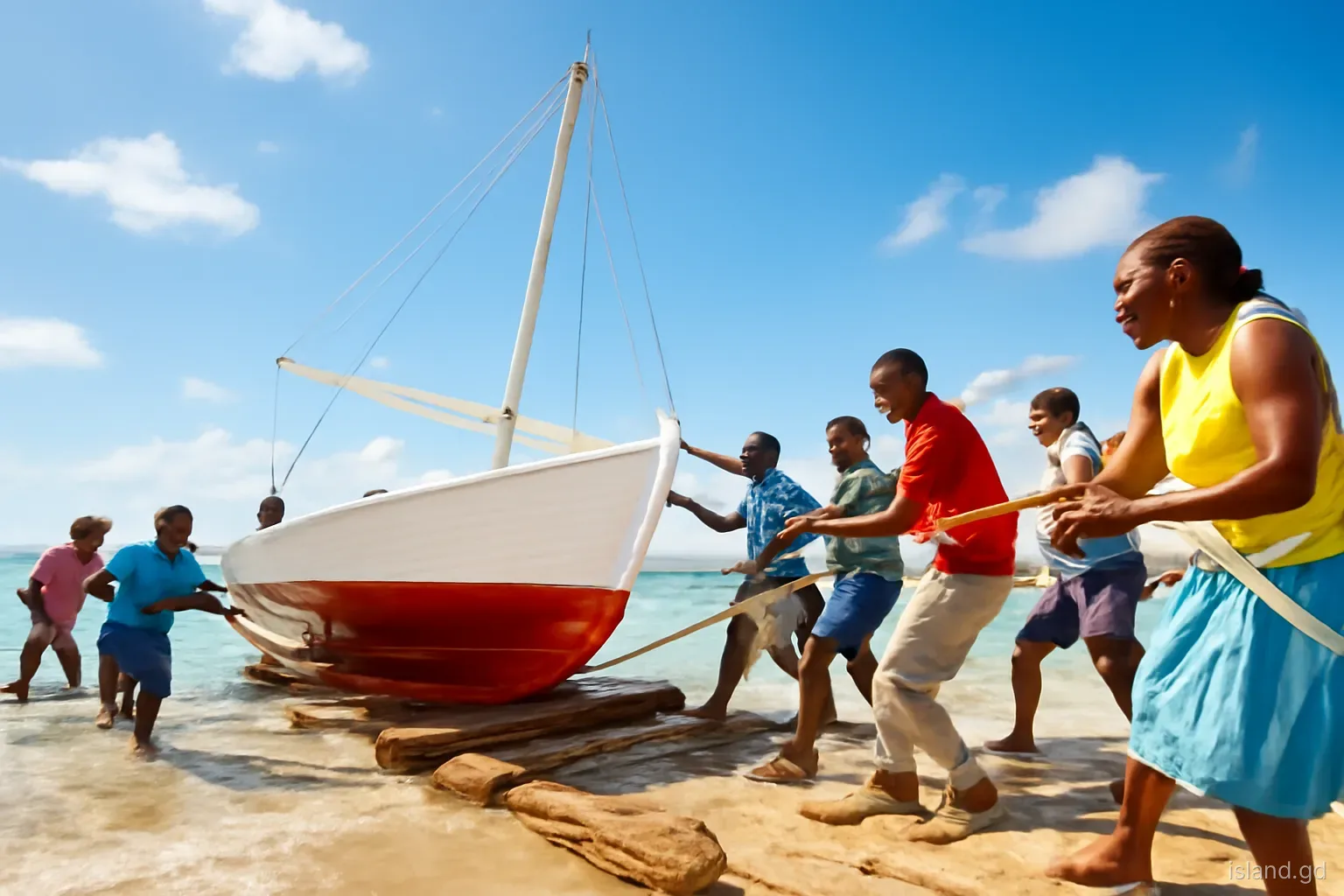
A wooden boat built on the beach at Windward or on Petite Martinique can take months or years to finish, and it leaves the land only once. The day it goes into the sea is one of the biggest occasions in the life of a family and a village. There is a church blessing, there is usually food cooked for everyone in the spirit of a saraka, there may be a Big Drum the night before, and at the decisive moment dozens of people take hold of ropes and haul the hull down to the water.
Boat launchings are less frequent than they once were, because fewer large wooden vessels are built and fibreglass has replaced timber for many working boats. When one happens, though, it draws people from across Carriacou and Petite Martinique and often from the mainland. Understanding the stages of the day helps visitors appreciate what they are watching and stay out of the way when it matters.
Why Windward and Petite Martinique build boats
Carriacou's north-east coast around Windward faces Petite Martinique across a short channel, and both communities have long lived from the sea: fishing, inter-island trading and, historically, carrying goods and people up and down the Grenadines. Boatbuilding on the beach supplied the vessels that made that life possible.
Local tradition links the craft to shipwrights of Scottish descent who settled in the area in the colonial era, and some Windward family names reflect that heritage. Whatever its origins, the skill became thoroughly local. Builders traditionally shape hulls largely by eye and experience rather than from formal drawn plans, passing techniques from father to son and from master to apprentice.
The best-known product is the Carriacou sloop, a sturdy wooden sailing vessel used for fishing, cargo and, increasingly, racing. Carriacou-built boats compete in the Carriacou Regatta Festival around the start of August, and some have sailed far beyond the Grenadines. Petite Martinique builders have produced fishing and cargo boats for generations.
Building up to the launch
The hull on the beach. A boat is built close to the water, often under the shade of trees, sitting on blocks with its keel and frames rising over months. Its progress is watched closely by neighbours, who have opinions on every plank.
Choosing the day. The launch date depends on the boat being ready, on tides and sea conditions, and on the family's ability to host a large gathering. Builders may also consult older relatives and pay attention to dreams and signs.
Naming and sponsors. The owner chooses a name, frequently honouring a family member, a saint or a hope for the boat's fortune. A godmother or sponsor may be appointed to stand with the boat at the blessing, much like a sponsor at a christening.
Preparing the ways. Timber skids or rollers are laid from the hull down the beach to the water, and the path is cleared. Ropes and blocks are rigged so a crowd can pull together.
Cooking and inviting. The family arranges food and drink on a scale to feed the village. Relatives abroad often contribute, and word goes round the island well before the day.
What goes into a wooden hull
A traditional Carriacou or Petite Martinique hull starts with the keel, a long backbone of heavy timber, followed by the stem and sternpost. The frames, or ribs, are the critical part. Builders have long preferred timber from naturally curved trees and branches, with white cedar a common local choice, so that the grain follows the shape of each rib and gives it strength without steam-bending.
Planking is fastened over the frames, then caulked to make the seams watertight, painted and fitted out with deck, mast and rigging. As local forests were cut over, suitable trees became scarcer and builders turned increasingly to imported planking timber, which raises costs and is one reason fewer big hulls are started today.
The tools have modernised, with power saws and drills alongside adzes and hand planes, but the method of shaping a hull by eye and adjusting it plank by plank remains recognisably the old one. Watching a hull take shape over several visits is one of the quiet pleasures of a longer stay at Windward.
The night before and the morning of
Many launchings are preceded by a saraka or a Big Drum, held near the boat or at the owner's home. The ancestors are honoured, the first dances call on them for protection, and food is set aside for them. For older islanders this step is essential: a boat that goes to sea without the old people's goodwill is, in their view, starting badly.
On the morning itself, a priest or pastor usually blesses the vessel. Prayers are said, holy water may be sprinkled, and the boat is formally named. Traditionally an animal, often a ram or goat, is killed nearby and its meat cooked for the feast; in some families a little of the blood is touched to the boat. Rum may be poured on the bow or a bottle broken against it.
By late morning the beach is full. People sit on rocks and walls, children climb trees, vendors arrive with drinks, and the owner and builder move between the boat and the guests, checking ropes and accepting congratulations.
How the hull reaches the water
The launch itself is a carefully managed piece of muscle power. The sequence usually runs like this:
- The builder's crew knocks away the blocks so the hull settles onto the skids or rollers, held upright by props and lines.
- Long ropes are run out along the beach and lines of volunteers, often dozens of people, take hold. Experienced hands are positioned at key points.
- A leader calls the rhythm, frequently with a work song or a chant, and the crowd pulls together on each call. The hull edges forward a little at a time.
- Rollers are moved from behind the boat to the front as it advances, a job for quick, careful people who know where to stand.
- As the stern meets the water the pace picks up, and with a last surge the boat floats. Swimmers and small boats take lines to bring it under control.
- Cheering, music and rum follow, and the feast begins in earnest. The owner may take guests for a short trip around the bay.
Staying safe and respectful as a spectator
Keep clear of the ropes and rollers. Unless you are invited to pull, stay well back from the lines and the path of the hull. A heavy boat on rollers can shift sideways without warning.
Pull if you are asked. Visitors are often welcomed onto the ropes. Follow the leader's calls, keep your feet clear of the rope and let go if told to.
Ask before photographing the blessing. The religious part of the day is solemn. Photograph from a distance, and avoid filming the animal sacrifice unless the family is clearly comfortable.
Bring a contribution. A bottle of rum or a drink for the gathering is a traditional gift. Hand it to the family rather than to the crew mid-task.
Respect the beach and the boatyard. Tools, timber and gear around a building site belong to working people. Do not sit on or move anything without asking.
Fewer launches, but a living tradition
The number of large wooden boats built each year has fallen. Suitable timber is harder and more expensive to obtain, fibreglass and imported hulls are cheaper to maintain, and young people have more options than following their fathers into boatbuilding. Some builders now concentrate on racing sloops, smaller fishing boats or repairs.
Hurricane Beryl in July 2024 added another blow. Windward and Petite Martinique suffered severe damage, and many boats, boat sheds and homes were destroyed or badly damaged. Rebuilding houses has understandably taken priority over new hulls, though the skills that built the boats also helped rebuild communities.
Regatta, school programmes and cultural organisations encourage the craft, and a launching remains a source of real pride. If you hear of one while on Carriacou or Petite Martinique, it is worth rearranging plans to attend. Ask your accommodation, taxi drivers or people in Windward; launch dates are shared by word of mouth rather than advertised.
Frequently asked questions
Where are traditional wooden boats built in Grenada?
The main centres are Windward on the north-east coast of Carriacou and Petite Martinique across the channel. Both have long boatbuilding traditions producing sloops, fishing boats and cargo vessels. Smaller-scale building and repair also happens elsewhere on Carriacou and on the mainland.
Why is an animal killed at a boat launching?
It is part of an older tradition of offering and feasting, linked to the saraka and honouring the ancestors. The animal, usually a ram or goat, is cooked and shared with the crowd. Some families also touch the boat with a little blood for protection, though practice varies.
Can visitors attend a boat launching?
Launchings are community events and visitors are usually welcome to watch, and sometimes invited to help pull. Keep clear of the ropes and rollers unless asked, behave respectfully during the blessing, and consider bringing a drink as a contribution to the gathering.
How long does it take to build a Carriacou sloop?
It varies with the size of the boat, the availability of timber and money, and the number of workers. A large sloop can take many months to a few years, especially when built alongside other work. Smaller boats are faster to complete.
Are boats still launched after Hurricane Beryl?
Building slowed sharply after Beryl because homes and livelihoods came first, and many boats and sheds were damaged. Launchings may still happen as families recover. Ask locally in Windward or Petite Martinique to find out whether one is planned during your visit.
What is the Carriacou sloop used for today?
Traditionally sloops were used for fishing and carrying cargo and passengers between islands. Today many are used for racing, especially at the Carriacou Regatta Festival, while others continue in fishing or charter work. They remain a symbol of Carriacou's seafaring identity.