From the deck of the ferry to Carriacou or a beach on the north coast, the birds overhead tell the story of the sea around Grenada. Frigatebirds hang motionless on the wind, brown boobies plunge into shoals, pelicans fold up and crash into the shallows, and in the breeding season terns swirl above rocky islets that most people only see as specks on the horizon.
The tri-island state is surrounded by small, uninhabited rocks and cays, from the islets off Levera in the north-east to the scattered rocks between the mainland and Carriacou. These places matter to seabirds because they are free of mongoose, rats and people, or at least were once. This guide covers the species most often seen, how to tell them apart, when they nest and how to enjoy them without causing harm.
The big, obvious birds
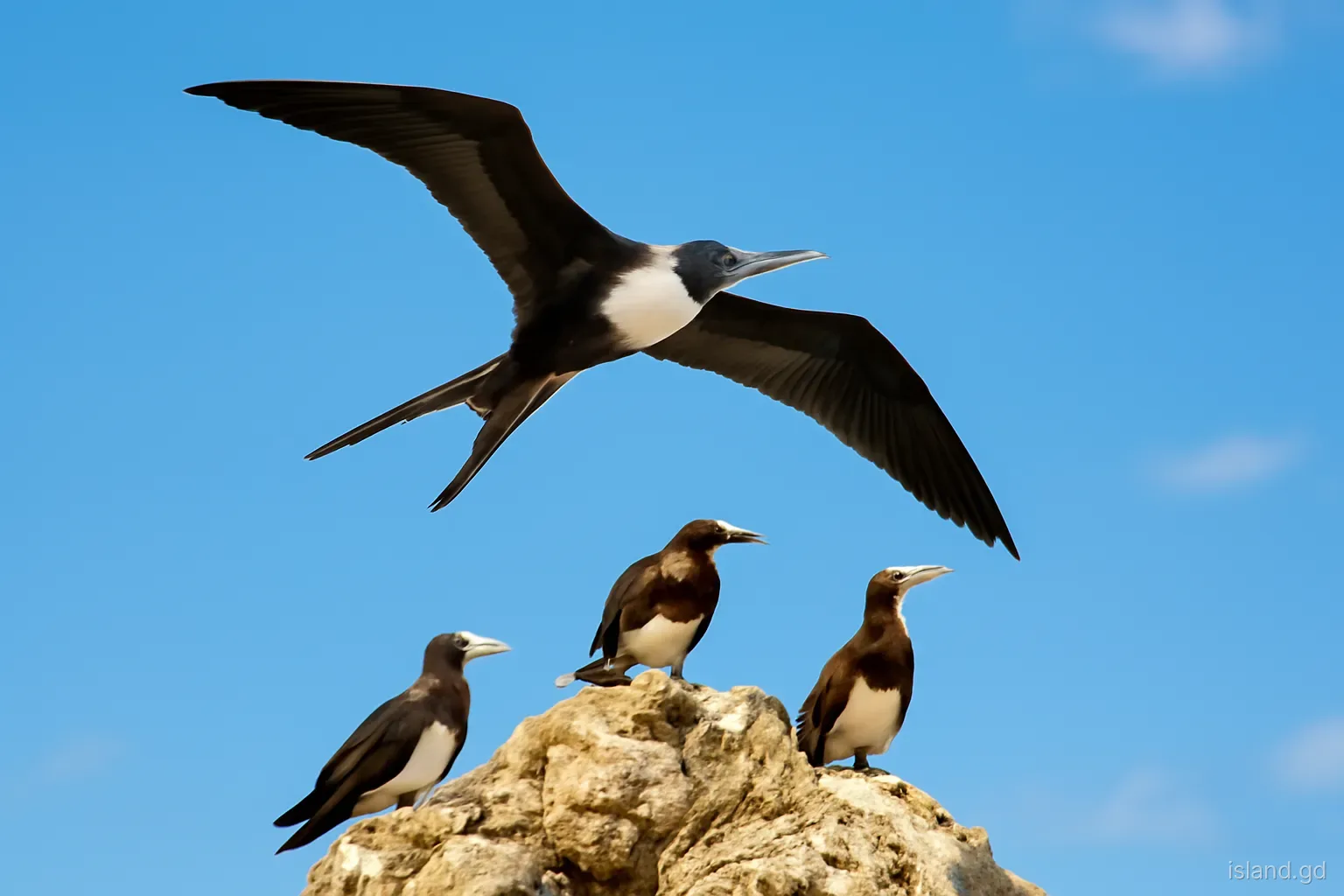
Magnificent frigatebird. Huge, black and angular, with long narrow wings bent at the wrist and a deeply forked tail that opens and closes like scissors. Males have a red throat pouch, inflated like a balloon during courtship; females have a white breast. Frigatebirds cannot settle on the water, and they often chase other seabirds to make them drop their catch.
Brown booby. A sturdy, cigar-shaped bird with a dark chocolate head, neck and back sharply divided from a white belly, and a pale yellowish bill. Boobies fly low over the water and dive at an angle to catch fish. They are among the most commonly seen seabirds around the islets.
Brown pelican. Large and grey-brown, with a huge bill and throat pouch. Pelicans fish close to shore, flying in lines just above the waves before rising and plunging bill-first. They often rest on boats, jetties and rocks in harbours and bays.
Red-footed booby. Smaller and more slender than the brown booby, with red feet and a bluish bill. It occurs in several colour forms and is seen less often, usually further offshore.
Terns, gulls and noddies
The laughing gull is the only gull commonly seen in Grenada, and mostly in the warmer months, when adults have a black hood and a dark red bill. Its loud, laughing call carries across bays and harbours. Outside the breeding season, the head turns mostly white with a grey smudge.
Terns are slimmer and more elegant than gulls, with pointed wings and, in most species, forked tails. The royal tern, large with an orange bill and shaggy black crest, is often seen resting on buoys and sandbars. Sooty and bridled terns, dark above and white below, gather around offshore rocks to breed in the summer months, and the brown noddy, an all-dark tern with a pale cap, nests on rocky ledges in the same areas.
Terns are often seen in mixed flocks working schools of small fish driven to the surface by tuna and other predators. A dense cloud of diving terns is something fishermen watch for, because it marks where fish are feeding. Seen from a boat, such a feeding frenzy is one of the liveliest sights on the water.
Red-billed tropicbird: the cliff dancer
The red-billed tropicbird is one of the most beautiful seabirds in the Caribbean. It is mostly white, with fine black barring on the back, a black stripe through the eye, a bright red bill and two extremely long central tail streamers that trail behind in flight. Seen against a blue sky, it is unmistakable.
Tropicbirds nest in holes and crevices on sea cliffs and steep rocky islets, where they can launch directly into the air, as they are clumsy on land. Pairs perform noisy display flights near the nest site, calling with shrill, rattling screams. Their breeding season in the region generally spans the drier part of the year, but timing can vary.
In Grenada, tropicbirds are most likely to be seen along rugged coastlines and around offshore rocks rather than on sheltered beaches. A boat trip along the north or around the Grenadines islets gives the best chance. Because their nest sites are so specific, disturbance on cliffs, including rock climbing or loud boats close in, can affect breeding.
Telling look-alikes apart at a distance
Most seabirds are seen far off, against glare, from a moving boat, so shape and behaviour matter more than colour. A few comparisons solve most problems.
Frigatebird or pelican? Both are large and dark, but the frigatebird is all angles, with thin, sharply bent wings and a forked tail, and it rarely flaps. The pelican is heavy and broad-winged, flies with slow, steady beats, often in a line, and has an obvious long bill held against the chest.
Booby or tern? Boobies are thick-necked, cigar-shaped birds that fly low with stiff wingbeats and dive at a slant. Terns are lighter, buoyant fliers with narrow pointed wings that hover briefly before dropping into the water.
Brown booby or juvenile? Young brown boobies are dull brown all over, lacking the clean white belly of adults, and can be mistaken for another species. Watch for a sharp dark-and-white line on any bird in the group to confirm.
Gull or tern? The laughing gull is bulkier, with broader wings, a heavier bill and a habit of sitting on the water or following boats for scraps. Terns rarely beg around boats and look more streamlined in every respect.
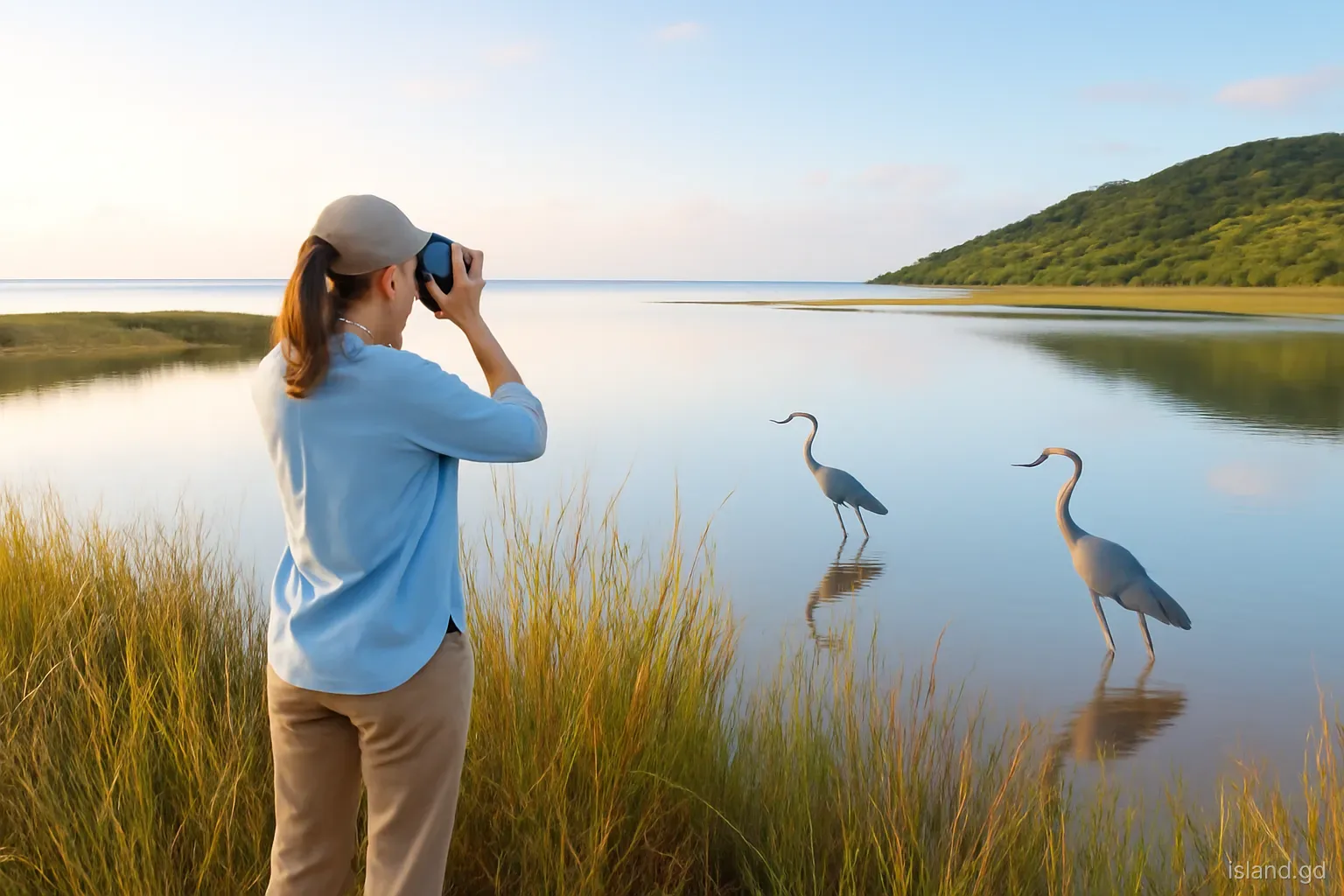
Binoculars of moderate magnification, around eight times, are easier to hold steady on a rolling boat than more powerful ones. A wide field of view helps to find fast-moving birds in the first place, and a strap or harness keeps them ready when spray comes over the bow. Photographers should favour fast shutter speeds and keep both eyes open to track birds entering the frame.
Where and when to look
Seabirds are visible year-round, but numbers and activity change through the year. These pointers help with planning.
- Ferry crossings between Grenada and Carriacou often produce boobies, frigatebirds and terns, especially when shoals are near the surface.
- The islets off Levera in the north-east, such as Sugar Loaf, Green Island and Sandy Island, can be scanned from the coast with binoculars or viewed from a boat.
- Harbours and bays such as the Carenage, Grand Anse and Tyrrel Bay on Carriacou are good for pelicans, gulls and resting terns.
- Tern and noddy breeding colonies are most active in the warmer months, roughly spring into late summer. That is also when landing on islets does the most harm.
- Frigatebirds and pelicans are present all year and often follow fishing boats returning to landing sites in places such as Gouyave.
- Early morning and late afternoon light is best for photography, with birds moving between feeding areas and roosts.
Threats and how to watch without harm
Seabirds on small islands face a long list of pressures. Introduced rats can reach islets and eat eggs and chicks, and a single colony can collapse after rats arrive. Egg collecting from tern colonies has long been a tradition in parts of the Caribbean and remains a threat where it continues. Overfishing reduces the shoals that birds depend on, and plastic and fishing line cause entanglement and poisoning.
Visitors can cause harm without realising it. Landing on a nesting islet sends adults into the air, leaving eggs and chicks exposed to burning sun or to gulls and frigatebirds. Dogs brought ashore are especially damaging. Drones flown low over colonies cause panic flights.
Good practice is simple: watch from the water, keep a generous distance, turn engines down near colonies, never land on islets with nesting birds, and take all rubbish and fishing line home. Report signs of rats on islets or egg collecting to the Forestry and National Parks Department or the Fisheries Division. Where islets fall within protected areas, landing may be restricted, so check before a trip.
Frequently asked questions
What is the large black bird with a forked tail seen over Grenada?
That is almost certainly the magnificent frigatebird. It has very long, angled wings and a deeply forked tail, and soars for hours without flapping. Males have a red throat pouch; females have a white chest. It is common along all coasts.
Do seabirds nest on Grenada's islets?
Yes. Several species, including terns, noddies, boobies and tropicbirds, use rocky islets around Grenada and the Grenadines for roosting and nesting, mostly in the warmer months. Many of these sites are vulnerable to disturbance and to introduced rats.
Can visitors land on the islets where seabirds nest?
Landing during the breeding season can cause serious harm, as adults flee and leave eggs and chicks exposed. Some islets are within protected areas with restrictions. The best approach is to watch from a boat at a distance and check rules with local authorities before any landing.
Where can pelicans be seen in Grenada?
Brown pelicans are common in sheltered bays and harbours, including the Carenage in St George's, Grand Anse Bay and Tyrrel Bay on Carriacou. They often perch on moored boats and jetties and fish close to shore, especially in calm morning conditions.
What is the white seabird with very long tail streamers?
That is the red-billed tropicbird, a white seabird with a red bill, black eye stripe and two long white tail feathers. It nests on cliffs and rocky islets and is most likely to be seen along rugged coasts and on boat trips.