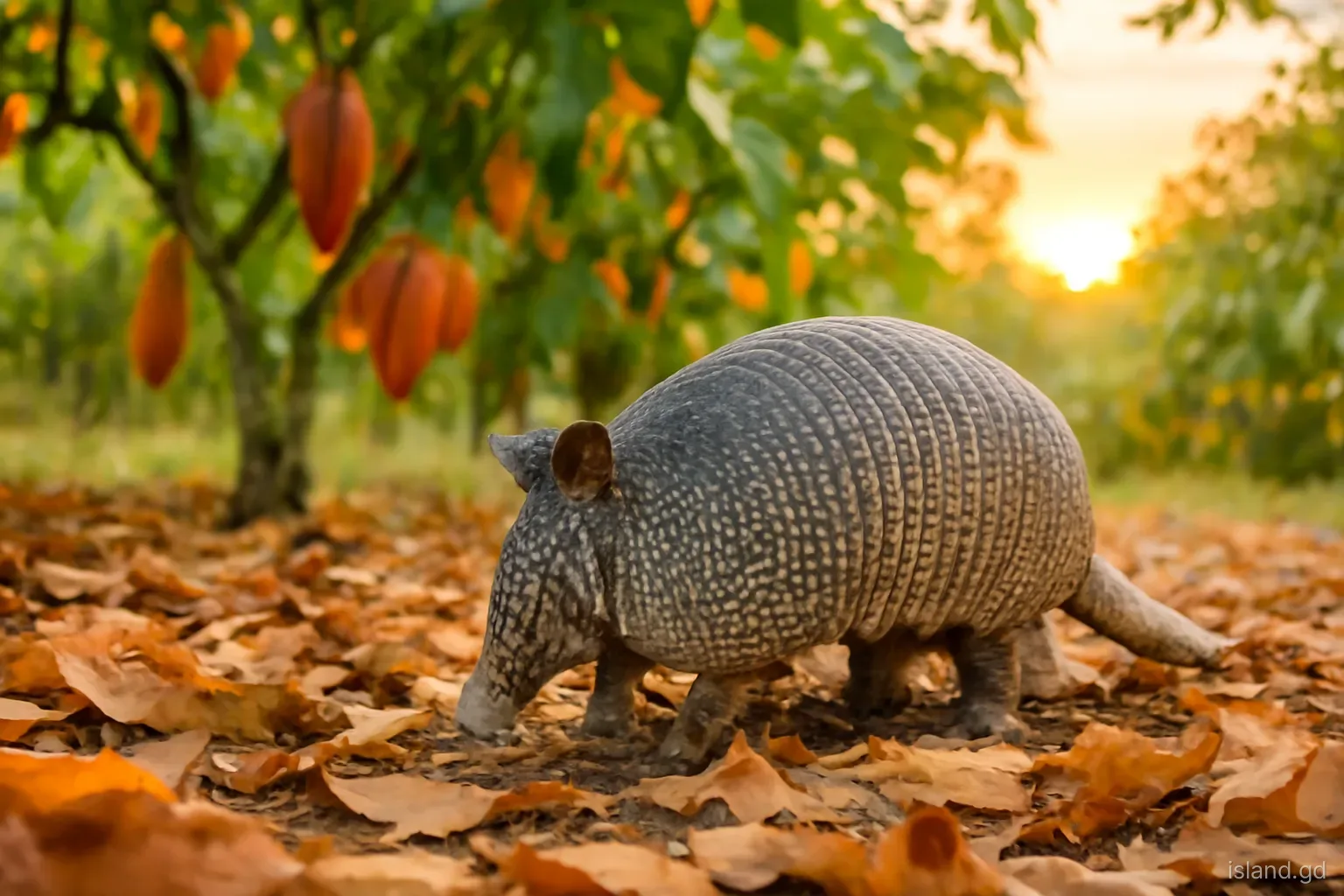
Ask a Grenadian about wild animals and the answer will probably include the tatou and the manicou before it gets anywhere near the monkeys. These two creatures, the nine-banded armadillo and the large opossum, are woven into rural life: as night-time visitors to gardens, as subjects of stories and, for generations, as wild meat cooked in the hills during the hunting season.
Like most oceanic islands, Grenada has only a handful of native land mammals, and bats make up a large share of them. Several of the others arrived with people, deliberately or by accident, from South America, Africa and Asia. The result is a small but mixed cast, most of it nocturnal, which explains why so many visitors leave thinking the island has no mammals at all.
This guide covers who is out there, how to recognise them, where and when they show up, and the legal and health points worth knowing.
The tatou: Grenada's armadillo
The tatou is the nine-banded armadillo, a species found from the southern United States to Argentina. It reached Grenada from the South American mainland, whether naturally or with human help is not certain. It is about the size of a small dog, covered in a jointed shell of bony plates with flexible bands across the middle, and has a long, pointed snout, large ears and a tapering armoured tail.
Tatou are mostly active at dusk and through the night, when they root through leaf litter and soil for insects, grubs and other small invertebrates. They dig burrows in banks and under roots, and the most common evidence of a tatou is a series of small, cone-shaped holes in soft earth where it has been feeding. They have poor eyesight but a strong sense of smell, and a foraging animal can be surprisingly oblivious to a quiet observer.
Tatou meat is considered a delicacy by many Grenadians, usually stewed or curried. Hunting pressure, combined with habitat loss, has made the animal much scarcer than it once was, and it is protected outside the legal hunting season. Seeing one is a matter of luck: a torch-lit walk along a quiet track through cocoa or secondary forest on a warm, damp night gives the best odds.
The manicou: a marsupial on the roof
The manicou is the common opossum, a marsupial related to the opossums of the Americas. It is roughly cat-sized, with coarse grizzled grey or blackish fur, a pale face, dark eyes, naked ears and a long, bare, partly prehensile tail. Females carry their young in a pouch and later on their backs.
Manicou are thoroughly nocturnal and highly adaptable. They live in forest, farmland and villages, raid fruit trees and chicken coops, and are notorious for taking up residence in roof spaces, where they make a surprising amount of noise. Their diet is broad: fruit, insects, eggs, small animals and kitchen scraps. When threatened, a manicou may hiss and show its many teeth, and it can give off a strong smell.
Like the tatou, the manicou is eaten as wild meat, traditionally smoked or stewed, and is subject to hunting rules. A smaller relative, the mouse opossum, also occurs in Grenada; it is tiny, with dark eye-rings, and is rarely noticed except when it turns up in a bunch of bananas or a storeroom.
If manicou move into a roof, the practical approach is to find and seal entry points after the animal has left for the night, rather than trying to catch it. Do not handle one barehanded: it will bite if cornered.
The mongoose: an introduction that went wrong
Where it came from. The small Indian mongoose was brought to several Caribbean islands in the late nineteenth century to control rats in sugar cane fields. Grenada was one of them. It did little to solve the rat problem, because rats are active at night and the mongoose hunts by day.
What it looks like. A slim, low-slung, brownish animal with a long body, short legs and a long tapering tail, it usually appears as a quick streak crossing a road or vanishing into a hedge in daylight.
The damage. Mongoose eat eggs, ground-nesting birds, lizards, snakes, turtle hatchlings and poultry. They are considered one of the most damaging introduced species in the Caribbean and are part of the reason ground-nesting birds such as the Grenada dove struggle.
The health risk. In Grenada the mongoose is the main wild reservoir of rabies, which is present on the island. Never try to touch, feed or corner one. Any bite or scratch from a mongoose, or from a dog or cat that may have been exposed, needs prompt washing with soap and water and urgent medical attention.
Pets. Dogs and cats that encounter mongoose should be kept up to date with rabies vaccination, and a vet should be consulted after any fight.
Bats, rodents and the monkey
Bats are the most numerous and diverse native mammals on the island, with roughly a dozen species recorded. They include fruit-eating bats that feed on figs, mangoes and other fruit and help disperse seeds, nectar-feeding bats that pollinate flowers at night, and insect-eating species that hunt over gardens, rivers and streetlights. Some roost in caves and old buildings; others hide in foliage. Watching the sky at dusk from a veranda near trees will usually show bats emerging.
Rats and house mice arrived with shipping and are widespread. They are a nuisance in homes and on farms and, like the mongoose, prey on eggs and chicks of wild birds. Good food storage and sealed bins are the best defence around a house.
The mona monkey, the island's only primate, completes the list of conspicuous mammals. It is an introduced species from West Africa and lives mainly in the central mountain forest; it is covered in a separate article. Marine mammals such as dolphins and whales are seen in Grenada's waters, but they are a different world from the land animals described here.
Hunting, wild meat and the law
Hunting of some wild animals for food is part of Grenada's rural tradition, and it is regulated under the country's wildlife and forestry legislation. A few points help visitors and newcomers understand the situation.
- Certain species, traditionally including the tatou, manicou, mona monkey and iguana, have been huntable only during a defined open season, with protection for the rest of the year. Season dates and protected species can change, so confirm current rules with the Forestry and National Parks Department.
- Hunting inside protected areas and forest reserves is restricted, and firearms are tightly controlled under separate laws.
- Wild meat dishes sometimes appear at local events during the open season. Ordering them is a personal choice, but buying out of season supports illegal hunting.
- Populations of some species, particularly the tatou, have declined noticeably, and conservationists have argued for stronger protection.
- Never buy or keep wild animals as pets. Taking young animals from the wild is harmful to populations and often illegal.
How to see Grenada's mammals without disturbing them
Most land mammals here are active after dark, so the best wildlife watching is often a quiet walk at dusk or after nightfall along a farm track or forest edge, with a torch fitted with a red filter or kept low. Move slowly, stop often and listen: a tatou rustles steadily through leaf litter, while a manicou in a tree may knock fruit down or show bright eyeshine in the torch beam.
Daytime brings the mongoose, crossing roads and paths, and the monkeys in the forest. Fruit trees in season attract almost everything, including bats at night, so a mango or fig tree near the edge of the forest is a good place to wait.
Keep your distance, never feed wild animals and do not try to catch one for a photograph. If you find an injured animal, contact the Forestry and National Parks Department or a local veterinary practice rather than taking it home. And if you are bitten or scratched by any wild mammal, treat it as a medical matter the same day.
Frequently asked questions
What is a tatou in Grenada?
Tatou is the local name for the nine-banded armadillo, an armoured, insect-eating mammal that roots through soil at night. It is traditionally hunted for meat in the legal season and has become scarce in many areas. Seeing one usually requires a quiet walk after dark.
What animal is a manicou?
Manicou is the Grenadian name for the common opossum, a cat-sized marsupial with grey fur and a long bare tail. It is nocturnal, eats almost anything, and often lives near houses, sometimes in roof spaces. It is also eaten as wild meat by some people.
Is there rabies in Grenada?
Yes. Rabies is present in Grenada, and the mongoose is its main wild carrier. Avoid touching any wild mammal, keep pets vaccinated and seek medical care the same day after any bite or scratch from a mongoose or an unknown animal.
Are there any dangerous mammals in Grenada?
There are no large predators. The main risks come from bites, particularly from mongoose because of rabies, and from monkeys used to being fed. Stray dogs can also be a nuisance. Keeping a distance and not feeding animals avoids nearly all problems.
When is hunting season in Grenada?
Grenada has traditionally had a defined open season for hunting certain species such as the tatou, manicou, iguana and mona monkey, with protection outside it. Dates and the list of species are set by regulation and can change, so check with the Forestry and National Parks Department.
Why was the mongoose brought to Grenada?
It was introduced in the late 1800s to control rats in sugar cane fields, as on several other Caribbean islands. The plan failed, because the mongoose hunts by day while rats are mostly nocturnal, and the mongoose turned to eggs, birds and reptiles instead.