The first question many people ask about Grenada's wildlife is whether there are dangerous snakes. The answer is reassuring: the island has no venomous snakes of medical concern. Unlike St Lucia and Martinique to the north, which have the fer-de-lance, Grenada and its Grenadines have nothing that poses a serious bite risk to people.
What Grenada does have is a lively and varied set of reptiles and amphibians. There is a tree boa found only on the Grenada Bank, iguanas that sun themselves on coastal trees, small lizards on every wall, geckos that call from the ceiling at night, a tortoise with red scales, and frogs whose whistling defines the sound of a tropical night. Learning a few of them makes the island feel more alive, and clears up some persistent myths.
The Grenada tree boa
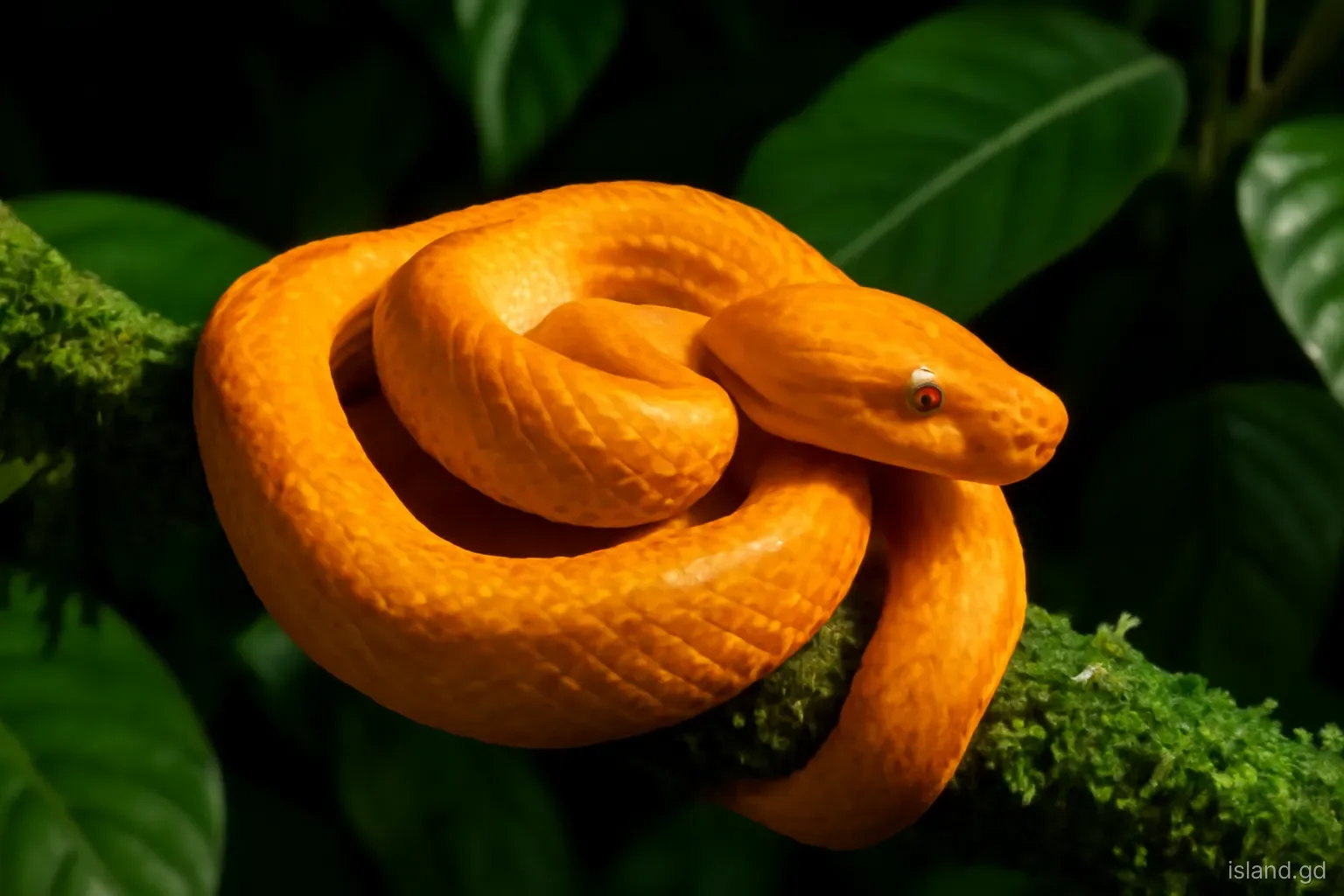
The Grenada tree boa, Corallus grenadensis, is the island's best-known snake and is found only on Grenada and in the Grenadines. It is slender, with a large head, a narrow neck and a long prehensile tail used to hold onto branches. Colours vary remarkably: individuals can be yellow, orange, tan, grey or brown, plain or patterned, and two snakes from the same area can look like different species.
Tree boas are nocturnal and spend the day hidden in vegetation. At night they hunt in trees and shrubs for lizards, frogs, roosting birds, rodents and bats, killing prey by constriction. They are not venomous. They can bite defensively if grabbed, and the bite of a large boa can draw blood, but it is not dangerous beyond the need to clean it.
They live in a range of habitats, from dry coastal woodland to fruit trees in farmland and gardens near the forest. Torchlight walks along vegetated tracks often reveal them, their eyes shining back from branches. Many are killed out of fear, which is unnecessary and harmful. If one turns up in a garden, it is best left alone or moved gently by someone experienced.
Other snakes
A small number of species. Besides the tree boa, Grenada has a handful of other snakes, including slender ground and tree-dwelling species and tiny burrowing snakes that look like earthworms. Several are found only on the Grenada Bank or in the southern Lesser Antilles.
None of medical concern. None of these snakes is considered dangerous to people. Some of the larger ground snakes may bite if handled, and any bite should be cleaned to prevent infection, but there is no snake on the island whose venom is a medical emergency.
Rarely seen. Most snakes are secretive and shy away from people. Ground snakes are often seen crossing paths or roads, especially after rain, but they move away quickly.
Under pressure. Mongoose, cats and habitat clearance have reduced snake populations across the Caribbean. Killing harmless snakes adds to that pressure and removes predators that help control rats and other pests.
Lizards: zandoli, geckos, iguanas and a big tegu
The small lizards on walls, fences and tree trunks are anoles, known by the Creole name zandoli across much of the Eastern Caribbean. Grenada has a large green species and a smaller brownish one, and males of both extend a coloured throat fan, called a dewlap, to signal to rivals and females. They feed on insects and are completely harmless.
Geckos appear on walls and ceilings at night, especially around lights where insects gather. They are pale, soft-skinned and have adhesive toe pads, and some give sharp chirping calls. They are welcome housemates that eat mosquitoes and moths. Older people sometimes regard geckos with suspicion, but they pose no risk.
The green iguana is the largest common lizard, found in coastal woodland and dry scrub, particularly in the south and on Carriacou. Adults can be well over a metre long including the tail, and they are often seen basking in trees or crossing roads. They are vegetarian and shy, but large males can lash with their tails and bite if cornered. Iguana has traditionally been hunted for meat in season.
Grenada also has a large tegu lizard, a heavy, ground-dwelling South American species that forages for eggs, fruit and small animals, along with ground lizards that dash across sunny paths. These bigger lizards are wary and run off long before most people get close.
The red-footed tortoise
The red-footed tortoise is a land tortoise of South America with a dark, domed shell marked with pale patches and bright red or orange scales on the legs and head. In Grenada and the Grenadines it is generally thought to have been introduced long ago, possibly by Amerindian peoples who carried tortoises as a food source. It lives in dry woodland and scrub, and on Carriacou in particular it has long been part of the landscape.
Tortoises eat fallen fruit, flowers, leaves and fungi, and they are most active after rain. Many families have kept them in yards, which has blurred the line between wild and domestic populations. Wild tortoises face pressure from collection, road traffic and habitat loss.
If you meet a tortoise on a road, it is acceptable to carry it gently across in the direction it was heading, holding the shell at the sides. Do not take tortoises away as souvenirs: exporting wildlife without permits is illegal, and the international trade in this species is regulated.
Myths, fears and mistakes
Fear of snakes runs deep in many communities, and the most common mistake is simply killing every snake on sight. In Grenada this achieves nothing for safety, since none of the snakes is dangerous, and it removes animals that eat rats and mice around homes and farms. The tree boa in particular suffers because its size and night-time habits make it look threatening.
Other beliefs attach to lizards and toads. Geckos are sometimes thought to be poisonous or to bring bad luck; they are neither, and they eat household insects. Iguanas are occasionally described as aggressive, when in practice they flee long before anyone gets close. The cane toad is a genuine hazard, but to dogs rather than to people, as long as hands are washed after contact.
Visitors make different mistakes: picking up lizards or frogs for photographs, which stresses the animals and can injure delicate species; moving rocks and logs without replacing them, which destroys shelter; and driving fast on rural roads at night after rain, when frogs, toads and snakes are crossing. Slowing down and leaving animals where they are found is the simplest rule.
Frogs, toads and what deserves caution
Amphibians are most obvious in the rainy season, when the nights fill with calls. A few points cover the main species and the genuine hazards among Grenada's smaller creatures.
- The high, two-note whistle heard on almost every warm night comes from tiny whistling frogs that hide in vegetation. They are rarely seen but extremely common in gardens.
- Grenada has an endemic frog found in the wet mountain forest around Grand Etang and other high areas. It is small, brownish and hard to spot, and its habitat is limited.
- The cane toad, locally called crapaud, is a large, warty toad introduced to many Caribbean islands. Its skin glands produce a toxin that can seriously poison dogs that bite or mouth it. If a dog does so, rinse its mouth with running water and contact a vet immediately.
- Centipedes, which can grow large in Grenada, give painful bites; shake out shoes and clothes left outside, and wear gloves when moving wood or stones.
- Scorpions occur but are small and their stings are generally not dangerous to healthy adults, though they are painful.
- Wash hands after handling any frog or toad, and never touch your eyes or mouth before doing so.
Frequently asked questions
Are there venomous snakes in Grenada?
No. Grenada, Carriacou and Petite Martinique have no venomous snakes that are dangerous to people. The fer-de-lance found on St Lucia and Martinique does not occur here. Some non-venomous snakes may bite if handled, so it is still best to leave them alone.
What is the Grenada tree boa?
It is a slender, non-venomous constrictor found only on Grenada and the Grenadines. It comes in many colours, from yellow and orange to grey and brown, hunts at night in trees for lizards, rodents and birds, and is harmless to people who leave it alone.
Are iguanas in Grenada dangerous?
Iguanas are shy plant-eaters and will normally flee. A large adult that is cornered or grabbed can scratch, bite or whip its tail, which can cause injury, so give them space. They are most common in dry coastal areas and on Carriacou.
What makes the whistling sound at night in Grenada?
The loud, high-pitched whistles that fill warm nights, especially in the rainy season, come from tiny whistling frogs hidden in leaves and grass. A single garden can hold many of them. They are harmless and almost never seen.
Are cane toads poisonous to dogs?
Yes. Cane toads secrete toxins from glands behind the head, and dogs that bite or lick them can suffer drooling, seizures and heart problems. Rinse the dog's mouth with running water from the side, without forcing water down the throat, and get veterinary help straight away.