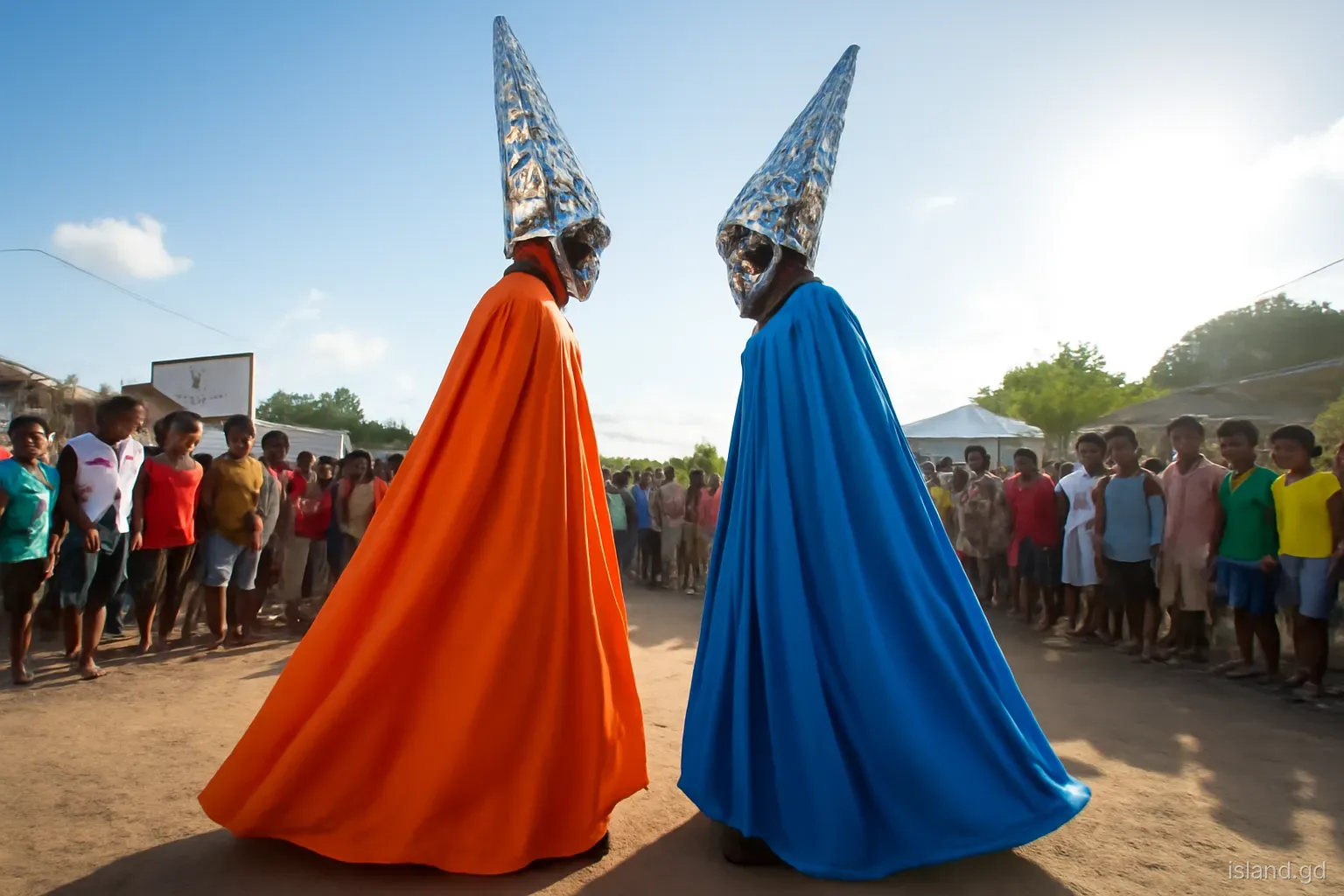
On the Monday of Carriacou's Carnival, which still follows the old pre-Lenten calendar rather than Grenada's August Spicemas, masked men in bright capes and tall headdresses walk the roads between villages carrying whips or sticks. When two of them meet, one challenges the other with a speech from Shakespeare's Julius Caesar. The other must answer with the correct following lines. Stumble, forget or misquote, and the opponent is entitled to strike.
Shakespeare Mas looks eccentric at first sight: a Roman political tragedy recited at a crossroads on a small Caribbean island. In fact it sits at the meeting point of several old traditions, from West African verbal contests and Caribbean stick-fighting to the recitation drilled into children in colonial schools. It is one of the most distinctive masquerades in the Caribbean, and it belongs entirely to Carriacou.
What actually happens on the road
Players, almost always men, gather in their villages on Carnival Monday and move toward Hillsborough over the course of the day, meeting other groups along the way. A confrontation begins when one masquerader steps forward and declaims a speech. The opponent has to respond with the speech that follows in the play, or with a fitting rebuttal from the text. Exchanges can run for several rounds as each tries to outlast the other.
The penalty for a mistake is a blow from the whip or stick, aimed at the padded headdress and upper body. Onlookers judge loudly; part of the fun for the crowd is catching a slip before the player himself realises it. The violence is real but ritualised: the costumes are built to absorb it, and players know the rules of where and how hard to hit.
By the afternoon, contests concentrate in Hillsborough, where the crowd is largest. Smaller duels break out wherever two groups meet, so people who live outside town often see as much in their own village as on Main Street.
The costume, piece by piece
The headdress. A tall, decorated crown or headpiece, frequently ornamented with small mirrors and bright trim, sits over a padded cap. It is both the most eye-catching element and protective equipment, since blows are aimed toward the head.
The cape. Long, colourful capes, often satin-like and edged with fringe or braid, hang from the shoulders. In motion they flare out, and in a duel they add to the theatrical stance players adopt.
The body padding. Layers of clothing beneath the outer costume soften the blows. Some players add a decorated shield or breastplate over the chest; designs and colours vary from group to group and year to year.
The mask. Faces are typically covered, which keeps the masquerade anonymous and adds to the sense that the player has become a character rather than a neighbour.
The whip or stick. Players carry a whip or stick, the weapon of the contest. Historically this was a tough, flexible implement; the exact form has changed over time, and the striking is deliberately aimed at protected areas.
Why Julius Caesar, and where the tradition came from
No written record pins down exactly when Shakespeare Mas began, so explanations rely on oral history and scholarship. A widely shared view is that it grew from the colonial school system, in which children memorised long passages of English literature, including speeches from Julius Caesar. Reciting them perfectly was a mark of education; turning them into a public contest with a whip was a way of claiming that learning and also of mocking the authority that imposed it.
The form also echoes African and Caribbean traditions of verbal combat, where wit, memory and delivery decide who wins, and of stick-fighting, known in the region by names such as kalenda. The confrontations at crossroads, the challenge and response and the role of the crowd as judge all fit that older pattern.
Julius Caesar suits the purpose. It is full of famous public speeches, accusations and replies, from the conspirators' arguments to Mark Antony's funeral oration. The play's themes of power, betrayal and rhetoric give players dramatic material, and the text is long enough that a challenger can always find a passage his opponent may not know.
How to watch Shakespeare Mas well
Seeing the masquerade properly takes a little planning, because it moves around the island and runs on its own schedule. A sensible approach:
- Confirm the dates. Carriacou Carnival falls on the Monday and Tuesday before Ash Wednesday, so it shifts between February and early March each year. Check the programme with the Carriacou carnival organisers or tourism office, especially while the island is still recovering from Hurricane Beryl.
- Book transport and a bed early. The ferry and small flights from Grenada fill up around Carnival, and accommodation on Carriacou is limited. Plan to stay at least the Sunday and Monday nights.
- Spend the morning in a village. Ask your host which villages have active groups, then position yourself on a main road where groups will pass. Early duels are often more relaxed and easier to follow.
- Move to Hillsborough by early afternoon. The biggest crowds and most competitive exchanges usually gather in town. Keep back from the open ground where players face off; a swinging whip does not always land where intended.
- Read the play beforehand. Even a quick reading of the key speeches in Julius Caesar transforms the experience, because you will recognise when a line is right and when a player has slipped.
Etiquette and things that catch people out
Do not step between players. The space between two masqueraders is a stage. Walking through it, even to take a photo, interrupts the contest and can put you in the path of a blow.
Expect real hits. This is not a mime. Players are struck, sometimes hard, and the crowd reacts strongly. Children usually watch from a safe distance, and so should you.
Ask before close-up photography. Players are generally used to cameras at Carnival, but a polite gesture before shooting at close range is appreciated, and some may prefer to stay anonymous.
Do not confuse it with Spicemas. Grenada's main Carnival, Spicemas, takes place in August on the mainland. Carriacou holds its own Carnival before Lent, and Shakespeare Mas belongs to that February or March event.
Drink water, not only rum. Carnival Monday is a long day in the sun on dusty roads. Carry water, a hat and cash, since card payments are not reliable across Carriacou.
The rest of Carriacou Carnival around it
Shakespeare Mas is the centrepiece most outsiders hear about, but it is one part of a compact, village-scale Carnival. The days before usually bring calypso and soca shows and band preparations, and Carnival Monday tends to start before dawn with J'ouvert, when revellers smeared in mud, oil or paint, including jab jab characters, move through Hillsborough to music trucks. By mid-morning many of them are asleep and the masqueraders take over the roads.
Carnival Tuesday is generally the day for costumed bands and parading in town, closer in spirit to the street carnivals found across the Caribbean. Because the island is small, the same faces appear at each event, and much of the atmosphere comes from people who left Carriacou returning for the weekend.
That mix explains why Shakespeare Mas feels so distinctive in context. Around it is the music and colour of a modern carnival; at its core is a contest built on memory, poise and a centuries-old play, carried by players who have often been doing it for decades.
Keeping the tradition alive
Like many traditional masquerades in the Caribbean, Shakespeare Mas depends on each generation choosing to learn long passages of text and to put up with real blows. Cultural groups, schools and carnival organisers on Carriacou have encouraged younger players, sometimes through competitions and demonstrations, so that the form does not shrink to a handful of older men.
The masquerade is also increasingly recognised beyond Carriacou. Cultural presentations on the mainland and documentary interest have made it better known, though its home remains the roads of the sister isle on Carnival Monday. Losing it would mean losing a uniquely local way of combining memory, performance and humour.
Visitors help most simply by showing up, watching respectfully and spending money locally during Carnival, particularly in the years after Beryl, when guesthouses, rum shops and food vendors are rebuilding their livelihoods.
Frequently asked questions
When is Shakespeare Mas held?
It takes place on Carnival Monday in Carriacou, the Monday before Ash Wednesday. That date moves each year with Easter, falling in February or early March. It is separate from Grenada's August Spicemas, so check the Carriacou carnival programme for the exact year.
Is Shakespeare Mas dangerous for spectators?
Spectators who stay back from the open ground where players duel are generally safe. The blows are meant for the opponent, aimed at padded areas, but a swinging whip can stray. Keep children back and avoid walking between two masqueraders who are facing each other.
Do the players really recite Shakespeare?
Yes. The contest is built on speeches from Julius Caesar, and players memorise substantial passages. A challenger delivers a speech and the opponent must reply with the correct lines. Errors in wording or a failure to continue count as a loss in that round.
Can women take part in Shakespeare Mas?
The masquerade has traditionally been performed by men, and it remains overwhelmingly male. Women are very much part of Carnival in Carriacou in other roles and other bands. Any change in who plays is a decision for the community and organisers.
Where is the best place to see it?
Hillsborough usually draws the largest crowds and most contests in the afternoon. Villages along the main roads see groups pass earlier in the day, which can be easier to watch. A local host can tell you which villages have active players that year.
Is Shakespeare Mas performed anywhere else?
It is specific to Carriacou. Groups have demonstrated it at cultural events on mainland Grenada and elsewhere, but as a living carnival tradition it belongs to the roads of Carriacou on Carnival Monday.