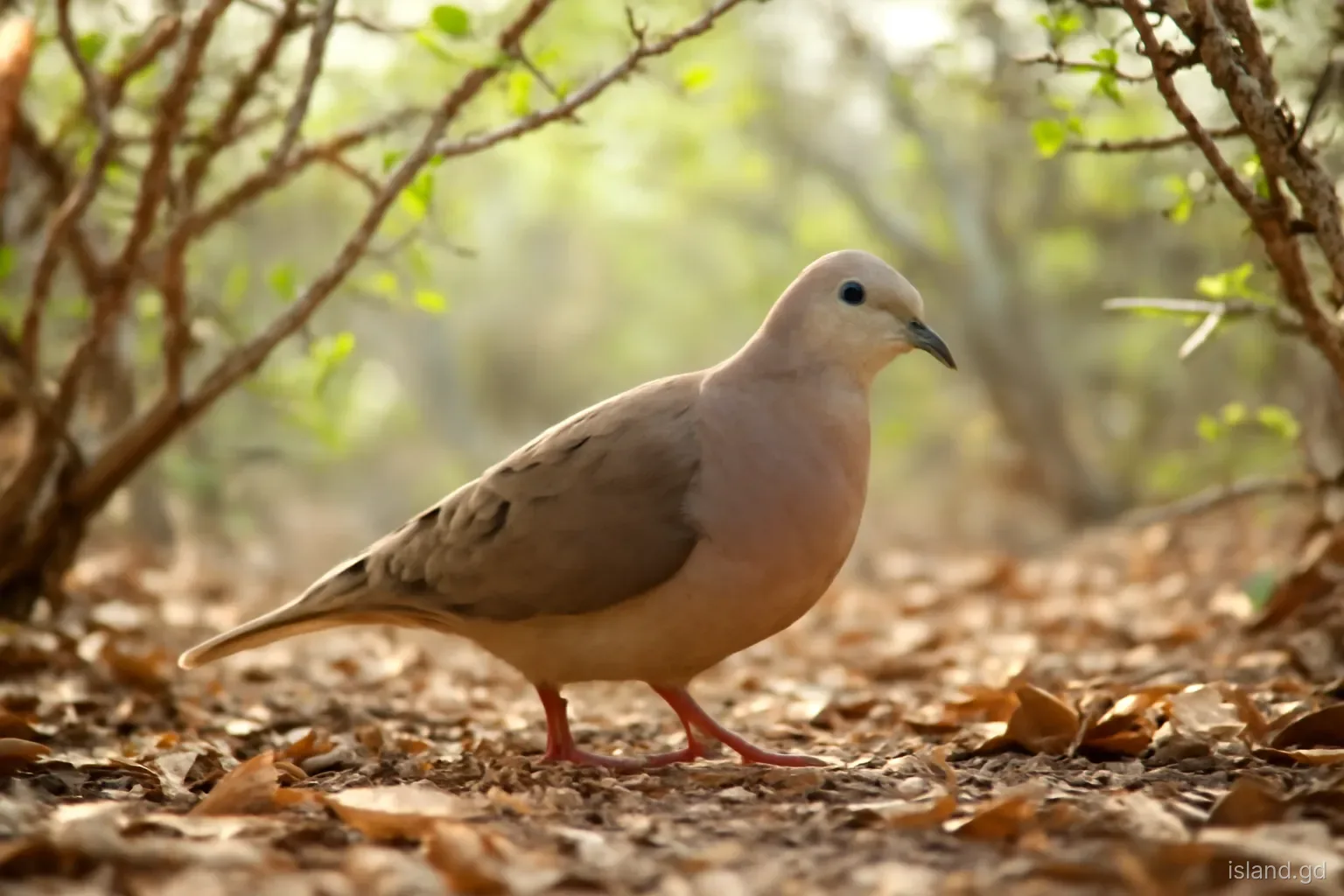
Most visitors to Grenada never see the national bird, and plenty of Grenadians have not either. The Grenada dove, Leptotila wellsi, lives only on this island, in a thin and broken band of dry scrub forest along the south-west and west coasts. It spends much of its time on the ground, it is shy, and its colours are designed to disappear against dead leaves. What gives it away is its voice.
The dove is classed as critically endangered. Surveys over the past few decades have repeatedly put the population in the low hundreds or fewer, and the forest it needs sits on exactly the kind of coastal land that is most attractive for housing, resorts and roads. That combination makes it one of the rarest birds in the Caribbean.
This page explains how to tell the Grenada dove from the island's other ground doves, how to recognise its call, where it hangs on, what threatens it, and how a visitor or resident can look for it without adding to the pressure.
What the Grenada dove looks like
The Grenada dove is a medium-sized, plump pigeon a little smaller than a town pigeon. The upperparts are a warm olive-brown, the breast is a soft pinkish or buff colour that fades to white on the belly, and the face and forehead are noticeably pale, almost whitish. When it flies, the underside of the wings flashes a rich reddish-brown, a feature shared with other doves in the genus Leptotila and often the first thing an observer actually sees.
It is easily confused with two commoner birds. The eared dove (often called the ground dove or "turtle dove" locally) is smaller, browner, with small black spots on the wing and a dark mark on the face, and it is happy in gardens, roadsides and yards. The common ground dove is tiny, sparrow-sized, and shuffles about in pairs on paths and lawns. A dove feeding confidently on someone's driveway is almost certainly not a Grenada dove.
The Grenada dove is a forest-floor bird. It walks quietly through leaf litter picking up seeds and fallen fruit, and when disturbed it tends to walk or run away under cover rather than burst into the air. If it does fly, it is usually a short, low flight to a branch inside the scrub.
Learning the call: the best way to find one
Field workers who survey the Grenada dove do it mostly by ear, and so should anyone hoping to find one. The call is a single, low, hollow note, often described as a soft "hooo" that falls slightly in pitch, repeated at regular intervals of several seconds. It carries surprisingly far through dry forest on a still morning, and once heard it is not forgotten.
The rhythm matters as much as the sound. Other doves on the island give multi-note or rolling coos; the Grenada dove repeats one note, pauses, and repeats it again with the patience of a clock. Several birds calling from different directions across a valley is a sign of a healthy patch of habitat.
Calling is most frequent early in the morning and again in the late afternoon, and it tends to increase with the rains, when breeding activity picks up. Midday in the dry season is the least productive time: the forest goes quiet and the birds sit in shade. Recordings made by conservation groups and bird-sound libraries are worth listening to before going out, because the call is soft enough to be mistaken for distant livestock or a person blowing across a bottle.
Where it survives
Mount Hartman, St George. The best-known stronghold is the dry forest around Mount Hartman on the south coast, set aside as a protected area for the dove in the 1990s. The land around it has been the subject of long-running arguments over development, which is a large part of why the bird is so often in the news.
The west coast around Halifax Harbour. A second important population lives in the dry hills of the west coast north of St George's, including the area known as the Perseverance Dove Sanctuary near Halifax Harbour. Much of the surrounding land is privately owned or disturbed.
Scattered patches between. Smaller groups have been recorded in other fragments of coastal scrub on the leeward side of the island. These patches are often too small to be secure on their own, which is why connecting corridors of forest matter.
Not on Carriacou or in the rainforest. The dove is not found in the wet mountain forest of Grand Etang, and it does not occur on Carriacou or Petite Martinique. Anyone reporting one from those places has almost certainly seen another species.
Why it is so rare
The Grenada dove depends on low-lying dry forest: thorny, deciduous scrub that loses many of its leaves in the dry season and grows on poor, rocky soils near the sea. That habitat was never extensive on a mountainous island, and over the centuries much of it was cleared for estates, grazing and charcoal. In recent decades the main pressure has been building: houses, roads, tourism developments and the services that come with them, all of which favour the same gentle coastal slopes.
Introduced predators add to the problem. Mongoose, rats, feral cats and opossum take eggs and young from nests built low in trees and shrubs, and a ground-feeding bird with a small population can lose a large share of its breeding success in a bad year. Bush fires in the dry season can destroy patches of habitat outright.
Hurricanes are a further risk. Hurricane Ivan in September 2004 stripped and flattened large areas of forest across the island. A species reduced to a few small groups has little buffer against a single violent event, which is why conservationists stress keeping several separate populations alive rather than relying on one sanctuary.
How to look for it responsibly
Seeing a Grenada dove is a privilege, not a guarantee, and the bird's rarity means behaviour around it matters. A few practical rules keep a search productive and harmless.
- Go with someone who knows the sites. The Forestry and National Parks Department, local birding guides and conservation groups can say which areas are accessible and whether permission is needed to cross private land.
- Start early, ideally around first light, and plan to listen more than walk. Standing still near the edge of the scrub often works better than pushing into it.
- Do not play recordings of the call to draw birds in. In a population this small, repeated playback can disrupt territories and breeding.
- Keep to existing tracks. Dry forest recovers slowly, and trampling seedlings in the understorey does real damage.
- Never light fires, discard cigarettes or leave rubbish in dry-season scrub, when the leaf litter burns easily.
- Report sightings with location and time to a recognised conservation body; records from new places can help to map surviving groups.
Mistakes and misconceptions
The most common mistake is assuming that any dove in a dry area is the national bird. Eared doves are abundant and adaptable, and they turn up everywhere from beaches to car parks. If the bird is spotted, small, bobbing on a lawn or flying up in a noisy clatter, it is not the Grenada dove.
A second misconception is that a protected area means the species is safe. Sanctuaries on paper only work if the forest within them is intact and large enough, and if the land around them is not cut off by development. Several studies have pointed out that the dove needs habitat beyond its formal reserves.
Finally, people often expect a bright, showy bird because it is a national symbol. The Grenada dove is subtle: its beauty is in the warm browns, the pale face and the rufous flash of the wings, and in a call that defines the sound of the dry coast on a still morning. Treating it as an attraction to be ticked off misses the point; it is better understood as a measure of how much of Grenada's original coastal forest is left.
Frequently asked questions
Is the Grenada dove really found only in Grenada?
Yes. The Grenada dove is endemic to the main island of Grenada and has never been recorded naturally anywhere else. Its closest relatives are other Leptotila doves of Central and South America, but this species evolved here and survives only in a few areas of dry coastal forest.
How many Grenada doves are left?
Estimates vary between surveys and methods, but they have consistently placed the population in the low hundreds or below, which is why it is listed as critically endangered. Exact numbers are hard to pin down for a shy forest bird detected mainly by its call.
Can visitors go to Mount Hartman to see the dove?
Access arrangements and the condition of trails can change, especially given development activity in the area. Check with the Forestry and National Parks Department or a local birding guide before going, and expect to hear the bird far more often than you see it.
When was the Grenada dove named the national bird?
The dove was adopted as Grenada's national bird in the latter part of the twentieth century, reflecting both its uniqueness to the island and concern for its survival. It sits alongside other national symbols such as the nutmeg and the bougainvillea.
What does the Grenada dove eat?
It feeds mainly on the ground on seeds, small fallen fruits and other plant material, and may take small invertebrates. That diet is closely tied to the plants of dry deciduous forest, which is one reason it does not adapt well to gardens or cleared land.
How can residents help the Grenada dove?
Support protection of remaining dry forest, keep cats indoors in dove areas, avoid clearing scrub on coastal land unnecessarily, prevent dry-season fires, and pass sighting records to conservation groups. On private land near known sites, leaving native scrub standing is one of the most useful things an owner can do.