Switch on a light in Grenada and, in most cases, the power comes from burning imported diesel. The national grid on the mainland is supplied mainly by Grenlec's power station at Queen's Park, just north of St George's, with separate systems on Carriacou and Petite Martinique. Fuel has to be shipped in, its price swings with world oil markets, and those costs flow directly into electricity bills that are among the higher ones in the region.
That dependence is both an economic burden and a climate problem, and Grenada has committed to shifting toward renewable energy. Solar panels are increasingly common on rooftops, utility-scale solar and battery projects have been developed, and the government has pursued geothermal exploration in the north of the mainland. This article explains how the system works today, what is changing and what households and businesses should think about before investing in their own generation.
How Grenada's electricity system works
Grenada Electricity Services Ltd, known as Grenlec, has long been the country's main electricity utility, responsible for generation, transmission and distribution on all three islands. For decades it held an exclusive licence. The Electricity Supply Act of 2016 restructured the sector, opening the way for independent power producers and creating a framework for renewable generation.
The same reforms established the Public Utilities Regulatory Commission, PURC, which regulates electricity tariffs, licences and standards. In principle, the regulator balances the interests of consumers, the utility and investors, and oversees the rules that allow households and businesses to connect their own solar systems.
Fuel costs are passed through to customers via a fuel charge that changes with oil prices, which is why bills can rise sharply during global price spikes. Because the islands are small and isolated grids, they cannot import electricity from neighbours, so every kilowatt-hour must be generated locally.
Why the transition matters for an island
Cost. Imported fuel drains foreign exchange and keeps electricity expensive, affecting households, hotels, manufacturers and farmers who rely on pumps and refrigeration.
Price shocks. Global oil price swings translate directly into bills. Locally generated renewable power has more predictable costs once installed.
Resilience. Hurricanes such as Ivan and Beryl showed how fragile centralised grids can be. Distributed solar with batteries can keep homes, clinics and communication systems running when lines are down.
Emissions. Electricity generation is one of the largest sources of Grenada's greenhouse gas emissions. Although the country's total emissions are tiny globally, cutting them supports its credibility in climate negotiations.
Jobs and skills. Installing and maintaining solar, batteries and other systems creates local work for electricians, engineers and technicians, though training must keep pace.
Solar: the fastest-growing option
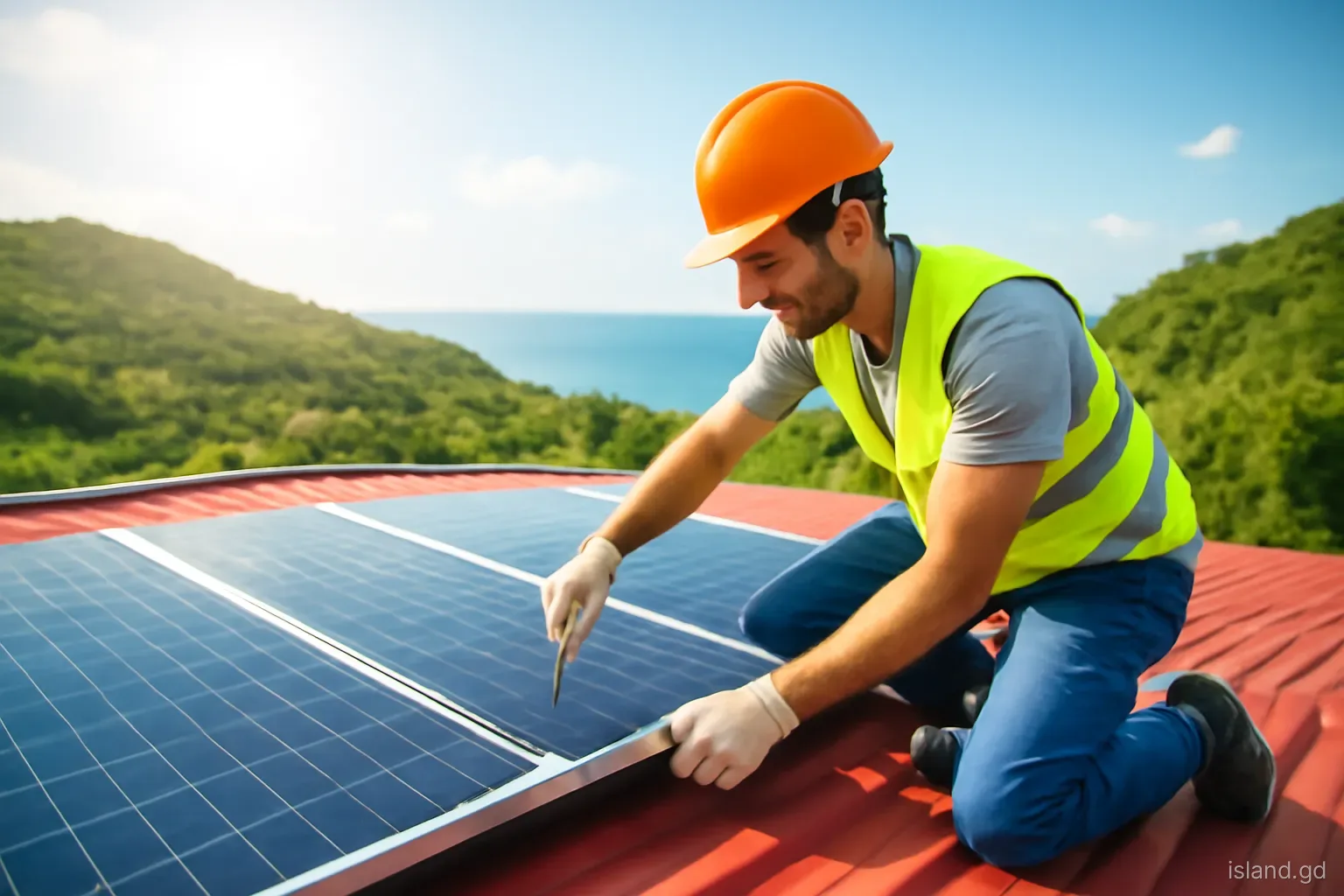
Grenada has strong, consistent sunshine year-round, making solar photovoltaic power the most practical renewable resource in the short term. Rooftop systems have spread on homes, businesses, hotels and public buildings, and larger solar installations connected to the grid add capacity.
Carriacou and Petite Martinique, with smaller grids, are well suited to solar combined with battery storage, which can reduce the amount of diesel burned and improve reliability. After Hurricane Beryl destroyed much of the sister isles' grid, reconstruction opened discussion about rebuilding with a much higher share of solar and storage.
Solar's main limitations are that it produces only during daylight, output drops in cloudy or rainy weather, and panels must be securely mounted to survive hurricanes. Batteries help with the first two issues but add cost. Installation quality, especially roof attachment, matters enormously in a hurricane zone.
Geothermal: the long-term prize
Grenada is a volcanic island, and the area around Mount St Catherine in the north has been identified as having geothermal potential. Geothermal energy uses heat from deep underground to produce steam that drives turbines, providing steady, round-the-clock power that does not depend on weather.
Successive governments have pursued exploration with support from international partners, including surface studies and plans for exploratory drilling to confirm whether a usable resource exists. Geothermal development is expensive and risky at the drilling stage: wells may not find sufficient heat or permeability, and costs can run high before any power is produced.
If successful, geothermal could supply a large share of the mainland's baseload electricity and significantly reduce diesel use. Neighbouring islands, including Dominica and St Vincent, have pursued similar projects, with mixed timelines, which shows both the promise and the difficulty. Progress in Grenada should be checked against the latest official announcements.
What the storms taught about the grid
Overhead lines on wooden or concrete poles are the most exposed part of any island grid. After Ivan in 2004, restoring power across the mainland took months in some areas, and after Beryl in 2024 the networks on Carriacou and Petite Martinique had to be largely rebuilt. During those periods, homes, shops and clinics with their own generation, whether diesel generators or solar with batteries, kept essential services going.
That experience has shifted the conversation from cost alone to resilience. Planners now talk about microgrids, smaller networks that can run independently of the main grid, critical facilities such as hospitals, shelters and water pumps with their own solar and storage, and placing some lines underground where it is practical.
None of this is cheap, and much depends on donor finance and the utility's investment plans. But each storm strengthens the argument that a grid built on many distributed sources, rather than one large diesel plant, is better suited to islands in a hurricane zone.
Before installing rooftop solar
Households and businesses considering solar should approach it methodically. A sensible sequence:
- Review your electricity bills for the past year to understand how much you use and when. Daytime-heavy users, such as businesses with air conditioning, benefit most.
- Check current rules with Grenlec and PURC on grid connection, metering and any credit for exported power. Rules and tariffs change, so get up-to-date information.
- Get quotes from several licensed installers, asking about panel and inverter brands, warranties, mounting systems and hurricane ratings.
- Have your roof assessed. Panels add weight and wind load; old or weak roofs may need repair or reinforcement first.
- Decide whether you want batteries. They add cost but provide backup during outages and after storms.
- Confirm insurance cover for the system, including storm damage.
- Plan for maintenance: cleaning panels of dust and salt, checking connections and monitoring output.
Common mistakes
Choosing on price alone. Cheap panels or poorly installed systems can fail early or blow off in storms. Mounting quality and warranties matter more than headline price.
Ignoring the grid rules. Connecting without approval can be unsafe and may breach regulations. Follow the official connection process.
Oversizing without storage. Generating far more than you use during the day may bring limited benefit if export credits are low. Size the system to your needs and the current rules.
Forgetting salt and heat. Coastal salt spray corrodes equipment, and heat reduces panel efficiency. Choose components rated for marine environments.
Expecting outage protection without batteries. Most grid-tied systems shut down during power cuts for safety. Without batteries, you will still lose power when the grid is down.
Electric vehicles and efficiency
Transport is the other big user of imported fuel. Electric vehicles are beginning to appear in Grenada, helped by short driving distances, though charging infrastructure, import costs and battery replacement remain considerations. EVs make most environmental sense when charged from solar rather than diesel-generated electricity.
Efficiency is often the cheapest step. LED lighting, efficient refrigerators and air conditioners, solar water heaters, ceiling fans and building designs that maximise shade and cross-ventilation can reduce electricity demand substantially. Traditional Caribbean architecture, with verandas, high ceilings and louvred windows, was designed to stay cool without machines.
For a small island, every kilowatt-hour saved reduces fuel imports. Combining efficiency, rooftop solar, utility-scale renewables and, eventually, geothermal is the realistic path to a cleaner and more resilient energy system.
Frequently asked questions
Where does Grenada's electricity come from?
Most electricity is generated by burning imported diesel, mainly at Grenlec's Queen's Park power station on the mainland, with separate generation on Carriacou and Petite Martinique. A growing share comes from solar, both rooftop and grid-scale, but fossil fuel still dominates.
Can you install solar panels on your house in Grenada?
Yes. Many homes and businesses have rooftop solar. Connecting to the grid requires following Grenlec and PURC rules on approval and metering. Use a licensed installer, ensure hurricane-rated mounting and confirm the current arrangements for exported power before investing.
Does Grenada have geothermal energy?
Grenada has potential geothermal resources around Mount St Catherine in the north. Exploration has been pursued with international partners, but confirming and developing a resource requires drilling and significant investment. Check the latest official updates for the project's status.
Why is electricity expensive in Grenada?
Electricity depends heavily on imported diesel, whose price follows world oil markets and includes shipping costs. Small, isolated grids also lack economies of scale. Fuel charges on bills rise and fall with oil prices, so costs can change significantly over time.
Will solar keep my power on during a hurricane?
Only if you have batteries and your panels survive the storm. Standard grid-tied systems shut off when the grid is down for safety. A system with battery storage and robust mounting can supply essential power after storms, as some households found after Beryl.
What is PURC in Grenada?
PURC is the Public Utilities Regulatory Commission, created under the 2016 electricity sector reforms. It regulates electricity tariffs, licensing and standards, and oversees rules for connecting renewable systems to the grid, aiming to balance the interests of consumers and suppliers.