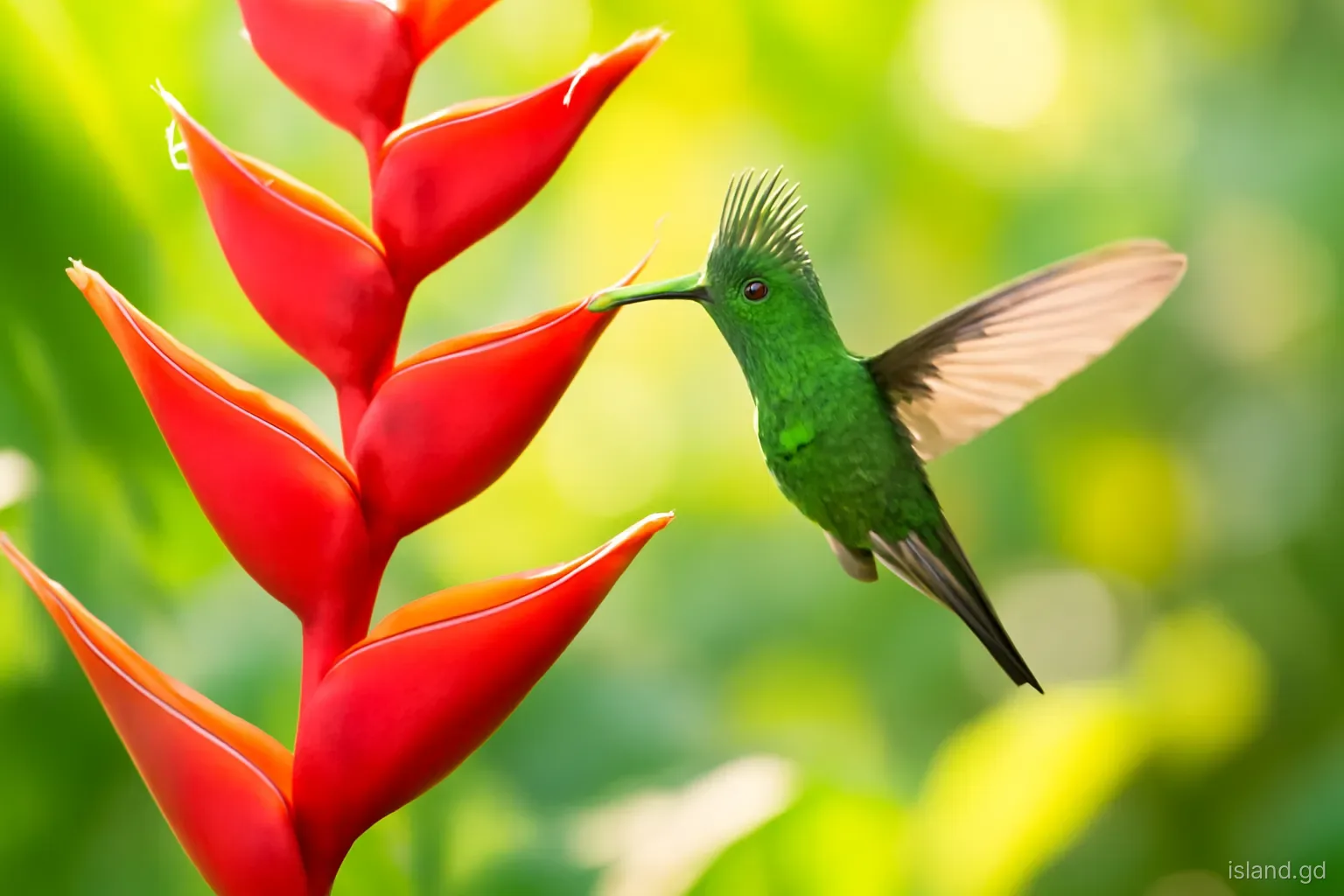
Sit on any veranda in Grenada with flowers nearby and a hummingbird will appear within minutes. They zip between hibiscus and ixora, chase each other off favourite bushes and sometimes hover at eye level as if inspecting the visitor. They are the most visible wild birds on the island and among the easiest to learn.
Three species do almost all the work. The tiny Antillean crested hummingbird is everywhere, from beach bars to mountain roads. The larger green-throated carib dominates big flowering trees and gardens. The rufous-breasted hermit keeps to shady forest and stream banks. A few others turn up rarely or in specific places. Knowing the three common birds turns a flash of green into something you can name.
The Antillean crested hummingbird
Size and shape. Very small, with a short, straight bill. It is the hummingbird most people notice first because it is so common and so bold, feeding low in gardens and hedges.
Males. Males have glossy green upperparts and a pointed crest on the head that catches the light in green or blue-green shades. The crest can be raised or flattened, and in poor light the bird looks simply dark.
Females. Females lack the crest and are greyish-white below with green upperparts, and pale tips to the outer tail feathers. They are easy to mistake for a different species when seen without a male nearby.
Where to see it. Almost anywhere with flowers, from sea level to the mountains: hotel gardens in Grand Anse, roadside lantana, flowering herbs in kitchen gardens and the ornamental beds of churches and schools. It is also common on Carriacou.
Behaviour. It feeds on small flowers that larger hummingbirds ignore and catches tiny insects in mid-air. Males defend small patches of flowers vigorously, chasing other birds with high squeaking calls.
The green-throated carib
The green-throated carib is a bigger, heavier bird with a long, gently down-curved black bill. In good light the throat and breast glitter emerald green, and there is a bluish patch on the breast, while the back is green and the tail a dark blue-black. In shade it can look almost black, and its size alone separates it from the crested hummingbird: side by side, the carib looks two or three times as bulky.
Caribs are the bullies of the flower world. They dominate rich nectar sources such as flowering trees, banana flowers, heliconias and large garden shrubs, and they will drive away smaller hummingbirds and bananaquits. A single carib may guard a tree for hours, perching on a dead twig between feeds and launching at any intruder.
The call is a sharp, dry chip or a rattling series of notes, often given in flight during chases. When two caribs fight over a tree, the clash of wings is audible from several metres away. Females and males look broadly similar, so behaviour and size, not plumage differences, are the practical way to identify this species in the field.
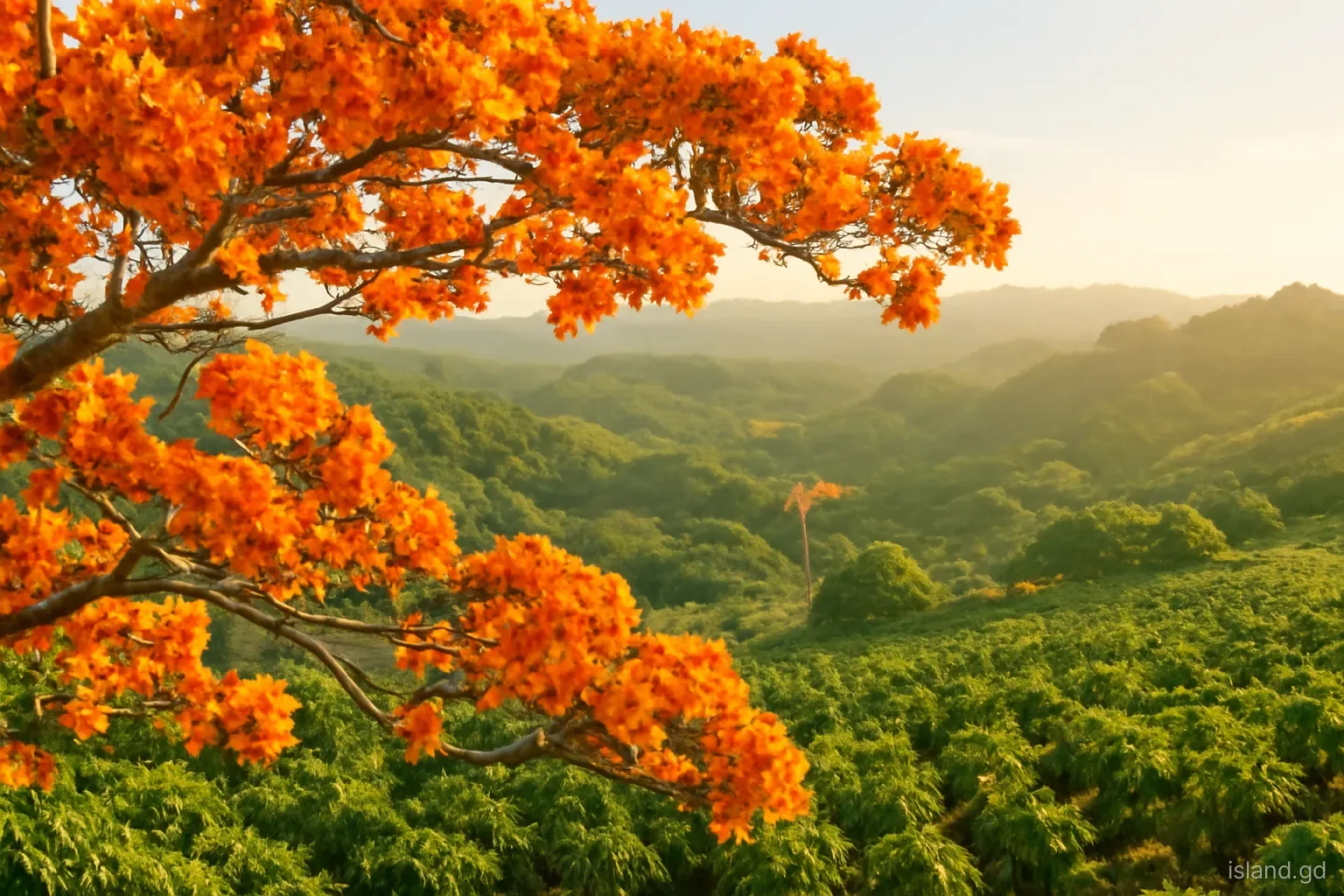
They are most common in lowland and mid-elevation areas with plenty of flowers, including gardens, estates and coastal woodland. In the dry season, when the orange-flowered immortelle trees bloom on cocoa estates and hillsides, caribs gather on them along with other nectar-feeding birds, which makes those trees good places to watch.
The rufous-breasted hermit
The rufous-breasted hermit is the odd one out. Instead of glittering green, it is bronzy-green above and warm rufous below, with a long, strongly curved bill and a rounded tail tipped with white. It is a South American species that reaches the northern edge of its range in the southern Lesser Antilles, and in Grenada it is a bird of shaded, humid places.
Look for it along forest trails, stream banks and in shady gardens close to woodland, particularly where there are heliconias, wild ginger and other tubular flowers that suit its curved bill. Hermits follow regular feeding circuits, visiting the same scattered flowers in turn, a habit sometimes called trap-lining. If one zooms past at knee height on a forest path, it is likely to return along the same route a little later.
Hermits are less aggressive than caribs and rarely sit in the open. A good tactic is to find a clump of heliconia in flower at the edge of the forest, for example around Grand Etang or a shady river valley, and wait quietly for ten or fifteen minutes.
Nests, eggs and the breeding cycle
Hummingbird nests are among the smallest bird nests in the world, and in Grenada they are easy to overlook. The female builds a neat cup of soft plant down, fine fibres and fragments of lichen or moss, bound together with spider silk so that it stretches as the chicks grow. The crested hummingbird often places its nest on a thin twig or even a dangling wire, sometimes surprisingly close to houses and verandas.
The usual clutch is two tiny white eggs. As with hummingbirds generally, the female does all the building, incubation and feeding; males play no part after mating and spend their time defending flowers. Chicks are fed regurgitated nectar and small insects, which is why insect-friendly gardens matter as much as flowers.
Breeding can happen in much of the year, with activity often rising when flowers are most plentiful. If you find a nest, look from a distance and do not touch it or the surrounding twigs: a mother that is repeatedly disturbed may abandon it, and handling leaves scent that can attract predators such as rats and cats. A long lens or binoculars give a better view than leaning in.
Rarer hummingbirds and look-alikes
Beyond the three common species, Grenada's position between the Lesser Antilles and South America means other hummingbirds are occasionally recorded. Treat any of these as a notable sighting worth photographing and reporting.
- The purple-throated carib, a large dark hummingbird with a purple throat and curved bill, is widespread further north in the Lesser Antilles. In Grenada it is scarce and mainly reported from higher, wetter forest.
- Other South American species have been noted as vagrants or in very small numbers. Records of these should be checked against a good field guide and, ideally, confirmed with photographs.
- The bananaquit, a small black-and-yellow songbird, often feeds at the same flowers and sometimes pierces the base of blooms to steal nectar. It perches rather than hovers, which separates it at once.
- Large hawk moths that feed at dusk can hover like hummingbirds. If it appears at twilight with antennae and a fat body, it is a moth.
- Female and young crested hummingbirds cause more confusion than any rare species. Check bill length and size before assuming something unusual.
Planting a garden that hummingbirds will use
Hummingbirds respond quickly to flowers, and a small garden in Grenada can support all three common species if it offers the right mix. These steps work for a hotel bed, a balcony or a village yard.
- Plant for a long flowering season. Mix shrubs such as ixora, hibiscus and pentas with tubular plants like heliconia, firespike and shrimp plant so something is in bloom every month.
- Include native or long-established plants where possible. Immortelle, flowering vines and wild heliconias in shadier corners support hermits and caribs as well as crested hummingbirds.
- Provide perches. A bare twig or thin dead branch near the flowers gives territorial birds somewhere to sit and watch.
- Avoid insecticide sprays. Hummingbirds feed small insects to their chicks, and chemicals reduce both the food supply and the birds' health.
- If using a sugar-water feeder, mix plain white sugar with water, never honey, and clean it every two or three days in the heat to prevent fermentation and mould.
- Keep cats away from feeding areas, as hummingbirds hovering low at flowers are easy prey.
Frequently asked questions
How many hummingbird species live in Grenada?
Three are common and resident: the Antillean crested hummingbird, the green-throated carib and the rufous-breasted hermit. A small number of other species, including the purple-throated carib, are recorded rarely or locally, so the full list depends on how vagrant records are counted.
Which hummingbird is most common in Grenada?
The Antillean crested hummingbird is the most widespread and most often seen. It visits small garden flowers from sea level to the mountains and is common on Carriacou too. Its small size and the male's pointed crest make it easy to recognise.
Do hummingbirds in Grenada migrate?
The common species are resident year-round, although they move locally to follow flowering. Birds may concentrate around immortelle and other trees in bloom during the dry season and spread out again when garden flowers increase with the rains.
Is it safe to use hummingbird feeders in Grenada?
Feeders are safe if kept clean. In tropical heat sugar water ferments quickly, so change it every two or three days and scrub the feeder. Use only white sugar and water, with no colouring, and place feeders away from spots where cats can ambush birds.
Where is the best place to photograph hummingbirds in Grenada?
Flowering gardens offer the easiest chances, as birds return to the same plants repeatedly. Hotel grounds, estate gardens and the edges of forest reserves with heliconia are all productive. Early morning light and patience near a favourite flower clump give the best results.