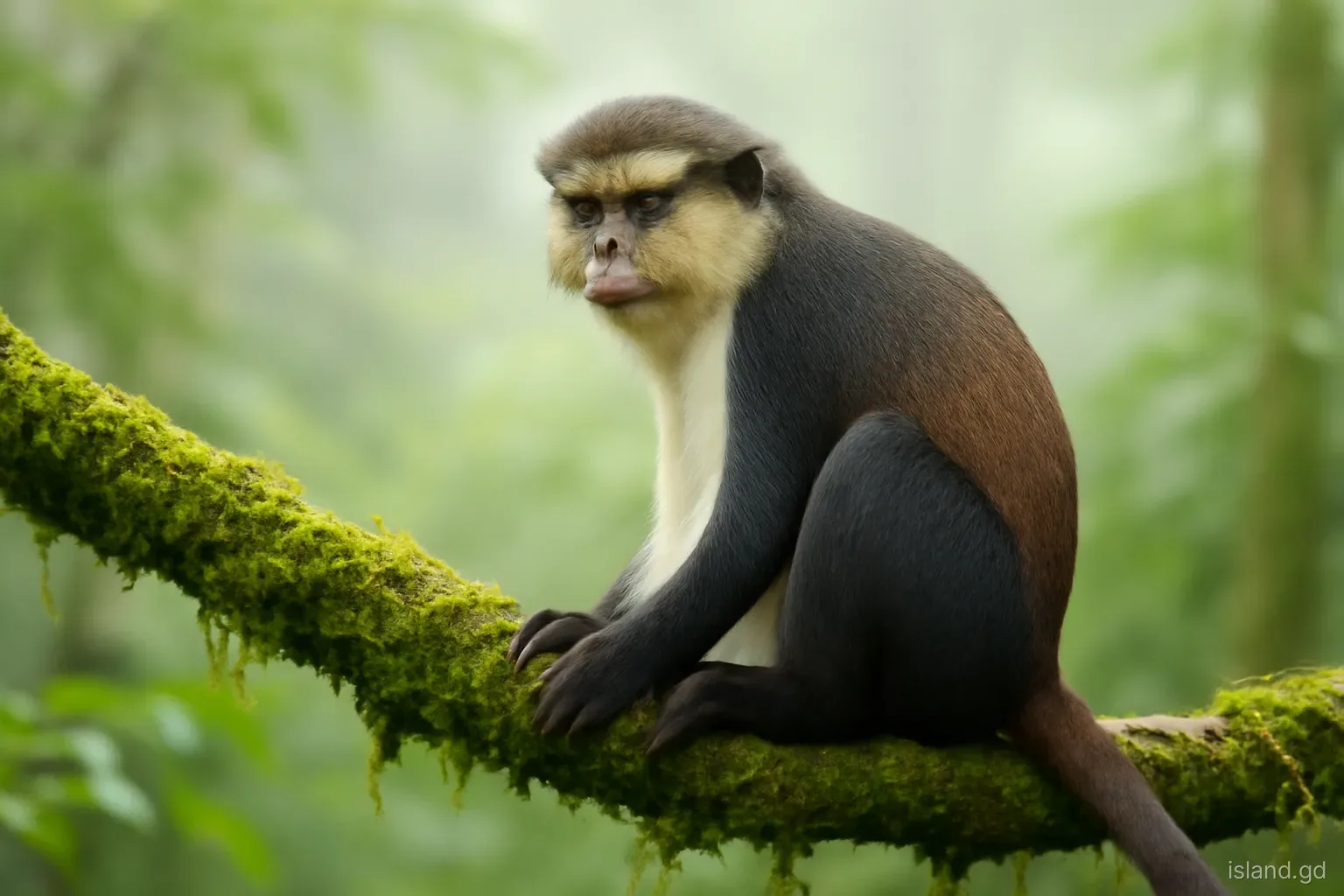
Grenada has one monkey, and it is not native. The mona monkey, Cercopithecus mona, comes from the forests of West Africa, roughly from Ghana to Cameroon, and is thought to have arrived in Grenada during the era of the transatlantic slave trade, most likely carried on ships in the eighteenth century. Over two or more centuries it has become a fixture of the island's mountain forest.
For many visitors, the monkeys at the edge of Grand Etang are the most memorable animals of the trip. For farmers in the hills they can be a nuisance that raids fruit trees, and for some families they have long been wild meat. Understanding all three views explains a lot about how the species lives here today. This page covers where the monkeys came from, how a troop is organised, the best places and times to see them, and the habits that keep both people and monkeys out of trouble.
How they got here
No written record pins down exactly when or how the first mona monkeys landed. The generally accepted explanation is that they were brought from West Africa as pets or curiosities on slave ships, and that some escaped or were released into the forest. Mona monkeys were similarly introduced to São Tomé in the Gulf of Guinea, which supports the idea that they travelled with Atlantic shipping.
Once in Grenada they found a forest with plenty of fruit and no large predators. There are no big cats or eagles here capable of taking an adult monkey, so the main checks on their numbers became hurricanes, food supply and people. The population spread through the central mountains and down into estates, river valleys and forested ridges in several parishes.
Because they have been isolated from African populations for so long, Grenada's monkeys are of interest to researchers studying how introduced species adapt to islands. Their story is also, quietly, part of the history of forced migration that shaped Grenada's people, food and culture.
What a mona monkey looks like and how a troop behaves
Colouring. Mona monkeys have a speckled brown back, a white or cream underside, a dark face with a paler muzzle and a pale band across the brow. The most distinctive mark is a pair of white patches on either side of the base of the tail, easy to see when a monkey climbs away from you.
Size. Adults are slender and long-tailed, with the tail longer than the body. Males are noticeably larger and heavier than females, and a big male sitting on a branch can look surprisingly bulky.
Troops. They live in groups, typically made up of several females with their young and one or a few adult males. Members keep in touch with soft calls, and a sharp alarm call sends the whole group up into the canopy.
Diet. Fruit makes up much of the diet, supplemented with leaves, flowers, seeds and insects. In mango and other fruit seasons they move to wherever trees are bearing, including farms and gardens.
Cheek pouches. Like their relatives, mona monkeys can stuff food into cheek pouches and eat it later in safety, which is why a monkey that seems to be chewing nothing may suddenly produce a mouthful of fruit.
Where to see them
The easiest place is the area around the Grand Etang Forest Reserve on the road between St George's and Grenville. Monkeys are often seen in the trees near the visitor area and along the road edges, especially early in the morning and later in the afternoon when they are most active. Sightings are likely but never guaranteed: a troop can spend the whole day deeper in the forest.
Hiking trails in the reserve, such as the shorter loops near the lake and the longer routes along the ridges, offer the chance of seeing monkeys behaving naturally, feeding in the canopy rather than waiting for handouts. Listen for branches shaking and fruit falling; monkeys are often heard before they are seen.
They also occur outside Grand Etang in forested valleys and hills of St Andrew, St John, St Mark and St David, and on some estates where fruit trees are plentiful. Monkeys are not found on Carriacou or Petite Martinique. On the mainland, the chances of meeting one on a quiet hill road are best near forest edges and fruiting trees.
Watching and photographing a troop well
The most rewarding monkey encounters happen away from the car park. A troop moving through the canopy is noisy in a particular way: branches bounce and swish, leaves and half-eaten fruit drop to the ground, and soft contact calls pass between animals. Stopping on a trail and staying still for several minutes usually lets the group settle and carry on feeding, often coming lower and closer than expected.
Light in the rainforest is dim and patchy, so a camera with a fast lens or a phone with a good low-light mode helps. Shooting slightly upwards against bright sky turns monkeys into silhouettes; it is better to wait for an animal to move onto a branch with leaves behind it. A long lens lets you fill the frame without crowding the animals, which also keeps their behaviour natural.
Watch for interactions rather than just poses: young monkeys chasing each other along a branch, an adult grooming another, a male pausing to scan the forest. These moments say far more about the species than a close-up of a monkey on a railing. Morning mist at Grand Etang can make atmospheric pictures, but it also means wet equipment, so carry a cloth and a plastic bag.
Feeding, handling and other mistakes
Most problems between people and monkeys in Grenada come from feeding. It feels harmless, but the consequences build up over time for both sides.
- Do not feed monkeys bananas, bread, crisps or anything else. Animals that associate people with food become bold, grab bags and can bite, and processed food is bad for their health.
- Avoid holding a monkey or letting one sit on your shoulder for photos. A bite or scratch from any wild primate should be cleaned and seen by a doctor, as monkeys can carry diseases transmissible to humans.
- Keep food out of sight and zip bags closed in picnic areas near the forest. Monkeys learn quickly which containers hold snacks.
- Do not approach a mother with a baby or a large male. Staring directly at a monkey can be read as a threat.
- Keep a respectful distance and let monkeys come and go. The best photographs are of animals foraging naturally in trees, not of animals begging on a wall.
- If you see someone keeping a monkey chained as a pet or selling one, it is worth reporting to the Forestry and National Parks Department.
Hunting, hurricanes and the population today
The mona monkey has a complicated legal and cultural status in Grenada. It has traditionally been hunted for meat, and wildlife law has historically allowed hunting of certain species, including the monkey, during a defined open season, with protection for the rest of the year. Rules and season dates can change, so anyone with a practical interest should confirm the current position with the Forestry and National Parks Department.
Hurricanes have a major effect. Hurricane Ivan in 2004 stripped much of the mountain forest of leaves and fruit, and monkey numbers were reported to fall sharply afterwards as food ran short. Recovery depends on the forest regrowing, and on hunting pressure not adding too much to natural losses.
Farmers in some hill communities regard monkeys as crop pests, particularly when troops raid bananas, cocoa or fruit trees. That conflict is unlikely to disappear, and it is one reason feeding by tourists, which draws monkeys towards roads and settlements, is discouraged. The aim of most people who work with the species is a stable population living mainly in the forest.
Frequently asked questions
Are mona monkeys native to Grenada?
No. They are native to West Africa and are believed to have been brought to Grenada on ships during the slave trade, probably in the 1700s. After centuries on the island they are part of Grenada's wildlife, but they are still regarded scientifically as an introduced species.
Is it safe to get close to the monkeys at Grand Etang?
Monkeys used to handouts can snatch food and occasionally bite or scratch. Keep a few metres away, do not offer food and do not let one climb on you. Any bite or scratch should be washed thoroughly and checked by a doctor promptly.
What is the best time of day to see mona monkeys?
Early morning and late afternoon are usually best, when troops are moving and feeding. Midday heat tends to send them into shade higher in the canopy. Fruiting trees near forest edges are good places to wait quietly.
Are there monkeys on Carriacou?
No. Mona monkeys in Grenada live on the mainland only, mostly in the central mountain forest and forested valleys. Carriacou and Petite Martinique have no monkeys, though they have other wildlife such as iguanas and seabirds.
Do people in Grenada eat monkey?
Monkey has traditionally been eaten as wild meat by some Grenadians, particularly in rural areas, and hunting has been permitted only in a defined open season under wildlife law. It is far less common than it once was and is not something visitors will find on restaurant menus.