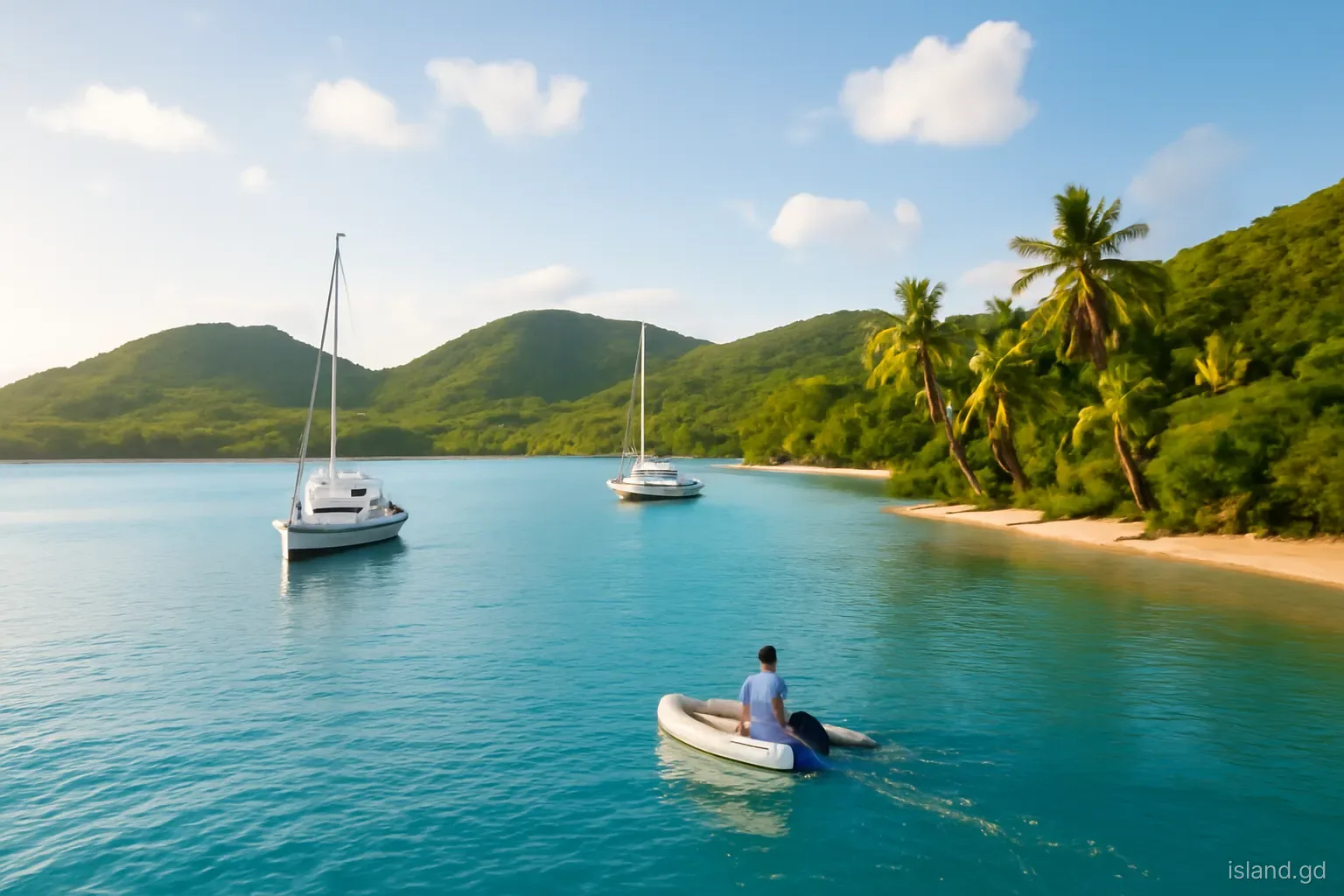
Tyrrel Bay is Carriacou's second waterfront after Hillsborough, and for sailors it is often the first. A wide, deep bay on the south-west coast, protected from the trade winds by the hills behind it, it has long been one of the most popular anchorages in the southern Grenadines. Along its shore runs Harvey Vale, a village where fishing boats, yacht dinghies, rum shops and small restaurants share the same strip of road and sand.
Behind the bay lies a mangrove lagoon known as the Oyster Bed, one of the island's most important natural habitats and a traditional storm refuge for boats. The whole area is part of the Sandy Island Oyster Bed Marine Protected Area, which ties together reefs, seagrass and mangroves along this coast.
This guide explains how the bay, the village and the lagoon fit together, what a stay here is like, and what changed after Hurricane Beryl.
The shape of the bay
Tyrrel Bay opens to the west, facing the Caribbean Sea, and is enclosed by hills to the north, east and south. That shape blocks the easterly trade winds and the Atlantic swell, so the water inside is usually calm even when the open sea is lively. The bottom is mainly sand and seagrass, which has made it a good holding ground for anchors.
The bay is roughly a couple of kilometres across, with Harvey Vale along its eastern and northern shore. A road runs along the waterfront, linking the village with the rest of the island. Hillsborough is around fifteen minutes or so away by road, past L'Esterre and the airport at Lauriston.
At the northern corner, a narrow channel leads into the mangrove lagoon. The southern side of the bay is quieter, with fewer houses, rising ground and views back towards the anchorage. Sunsets over the bay, with yacht masts silhouetted against the sky, are part of its appeal.
Harvey Vale: the village on the waterfront
Harvey Vale is a small, relaxed community stretched along the bay. Its waterfront road has a mix of homes, guesthouses, small bars and restaurants, minimarts and services for boaters. Fishermen keep boats on the beach and moorings, and children swim off the sand in the late afternoon.
Because of the yachting traffic, Harvey Vale is more international than most Carriacou villages, with visiting sailors from many countries mixing with residents. At the same time, it remains a local place, with churches, a school and families who have lived here for generations.
The pace is slow. Life follows the rhythms of the sea, the arrival of the ferry and the comings and goings of boats. Evenings are when the waterfront comes alive, as people gather at bars and on the road to talk. Businesses here open, close and change hands, and many were affected by Beryl, so check what is operating before relying on any particular place.
The Oyster Bed: mangrove lagoon and hurricane hole
The lagoon at the north end of Tyrrel Bay is lined with red mangroves whose arching roots reach into the water. Mangrove oysters grow on these roots, giving the area its name, and they have traditionally been harvested by local people. Today harvesting is subject to marine protected area rules, so it should not be attempted without checking what is permitted.
The lagoon is also an important nursery for fish and other marine life. Young fish shelter among the roots before moving out to the seagrass beds and reefs, and birds such as herons and egrets feed along the edges. The mangroves filter runoff from the land and protect the shore from storm surge.
For generations, boats have used the lagoon as a hurricane hole, tying into the mangroves to ride out storms. That practice has limits: mangroves can be damaged by lines and anchors, the space is small, and a direct hit from a major storm can overwhelm any shelter. Use is now subject to rules and coordination, which boaters should confirm with local authorities and the marine park office before the hurricane season.
Sailing and anchoring in Tyrrel Bay
Entry and clearance. Carriacou is a port of entry, and yachts arriving from abroad must clear in with Customs and Immigration. Clearance has been available at Hillsborough and, at times, Tyrrel Bay; arrangements change, so confirm before arrival and fly the correct flags.
Anchoring. The bay offers good holding in sand, but avoid anchoring on seagrass where possible and never on coral. Some areas may have moorings or restricted zones under marine park rules.
Marine park fees. Boats in the Sandy Island Oyster Bed Marine Protected Area may be charged fees for anchoring or mooring. Rates and collection methods change; check with the marine park office.
Boatyard and services. The bay has had a haul-out boatyard and marine services, making it a common place for yacht maintenance. Availability after Beryl should be confirmed directly.
Dinghy etiquette. Go slowly near swimmers and fishing boats, tie up only where permitted, and lock outboards at night.
Under the water: seagrass, reef edges and nursery life
Much of the floor of Tyrrel Bay is covered in seagrass, which is easy to overlook from a boat but is one of the most productive habitats in the Grenadines. Seagrass meadows stabilise the sand, keep the water clearer and feed or shelter a long list of creatures: juvenile fish, conch, starfish, rays and, at times, green turtles grazing on the blades.
Towards the headlands at either side of the bay, the seagrass gives way to rockier ground and patches of coral, where reef fish gather. Snorkelling along these edges, away from the anchorage and dinghy routes, can turn up parrotfish, wrasse, sergeant majors and small schools of fry, especially in calm morning conditions. Visibility is generally lower near the mangroves, where the water is richer in nutrients.
Anchors and chains are the biggest threat to these meadows, which is why the marine protected area encourages careful anchoring and moorings. Snorkellers can help by not standing on the bottom, not touching animals and leaving shells and starfish in place.
Hurricane Beryl and the bay
When Hurricane Beryl struck Carriacou on 1 July 2024 as a powerful Category 4 storm, it caused severe damage across the island. In the southern anchorages, many boats were damaged, sunk or driven ashore, and waterfront buildings in Harvey Vale and elsewhere were hit hard. Roofs were torn off, trees stripped and power and water supplies disrupted.
The recovery has been gradual. Wrecks have been removed in stages, homes and businesses repaired or rebuilt, and services restored over time. The bay remains a working anchorage, but some facilities that existed before the storm may have changed, closed or moved.
For visitors and sailors, the advice is simple: check current conditions before you go, ask locally about what is open, and be patient. Spending money in local businesses, from guesthouses to fish vendors, supports families who are still rebuilding, and courtesy goes a long way in a community that has been through a hard few years.
Before you go: practical checks
Tyrrel Bay is easy-going, but a little preparation avoids problems.
- Getting there. By road from Hillsborough by taxi or local minibus, or by water if arriving by yacht. Ask at the Hillsborough jetty about transport.
- Cash. Carry Eastern Caribbean dollars. Card acceptance varies and cash machines on the island are limited, mainly in Hillsborough.
- Water. Fresh water is precious on Carriacou. Use it carefully, and if you are on a boat, check where water can be bought.
- Swimming. Swim at the beach away from the anchorage and dinghy routes. Watch for boat traffic.
- Protected area rules. Do not collect shells, coral, oysters or other marine life, and do not anchor on reefs.
- Mosquitoes. Near the mangroves, mosquitoes and sandflies can be active at dusk. Bring repellent.
- After storms. If a storm threatens, follow advice from the National Disaster Management Agency and local authorities.
Frequently asked questions
Where is Tyrrel Bay in Carriacou?
Tyrrel Bay is on Carriacou's south-west coast, a short drive south of Hillsborough past L'Esterre and the airport. The village of Harvey Vale lines its shore. The bay is sheltered from the trade winds and is one of the main yacht anchorages in the southern Grenadines.
What is the Oyster Bed in Tyrrel Bay?
The Oyster Bed is a mangrove lagoon at the north end of Tyrrel Bay, named for the oysters that grow on mangrove roots. It is a nursery for fish, habitat for birds and a traditional hurricane refuge for boats, and it lies within a marine protected area.
Can you clear customs in Tyrrel Bay?
Carriacou is a port of entry, and clearance has been available at Hillsborough and, at times, at Tyrrel Bay. Arrangements change, so contact Customs and Immigration or check current cruising information before arrival to confirm where and when clearance is possible.
Is Tyrrel Bay a good hurricane hole?
The mangrove lagoon has long been used to shelter boats from storms, but it is small, rules apply and no shelter is guaranteed in a major hurricane. Beryl in 2024 damaged many boats in Carriacou. Plan carefully with insurers and local authorities.
Was Tyrrel Bay affected by Hurricane Beryl?
Yes. Beryl hit Carriacou in July 2024, damaging many boats in the bay and buildings in Harvey Vale. Recovery has been ongoing, wrecks have been removed in stages and businesses reopened gradually. Check current conditions and services before visiting.
Can you swim in Tyrrel Bay?
Yes, the water is usually calm. Swim from the beach away from the anchorage and dinghy routes, where boat traffic is a hazard. Avoid swimming near the lagoon entrance and mangroves, where visibility is lower and boats pass through the channel.